


Peptide Calculator – Dosage, Reconstitution & Syringe Units
Dragon Pharma Peptide Calculator
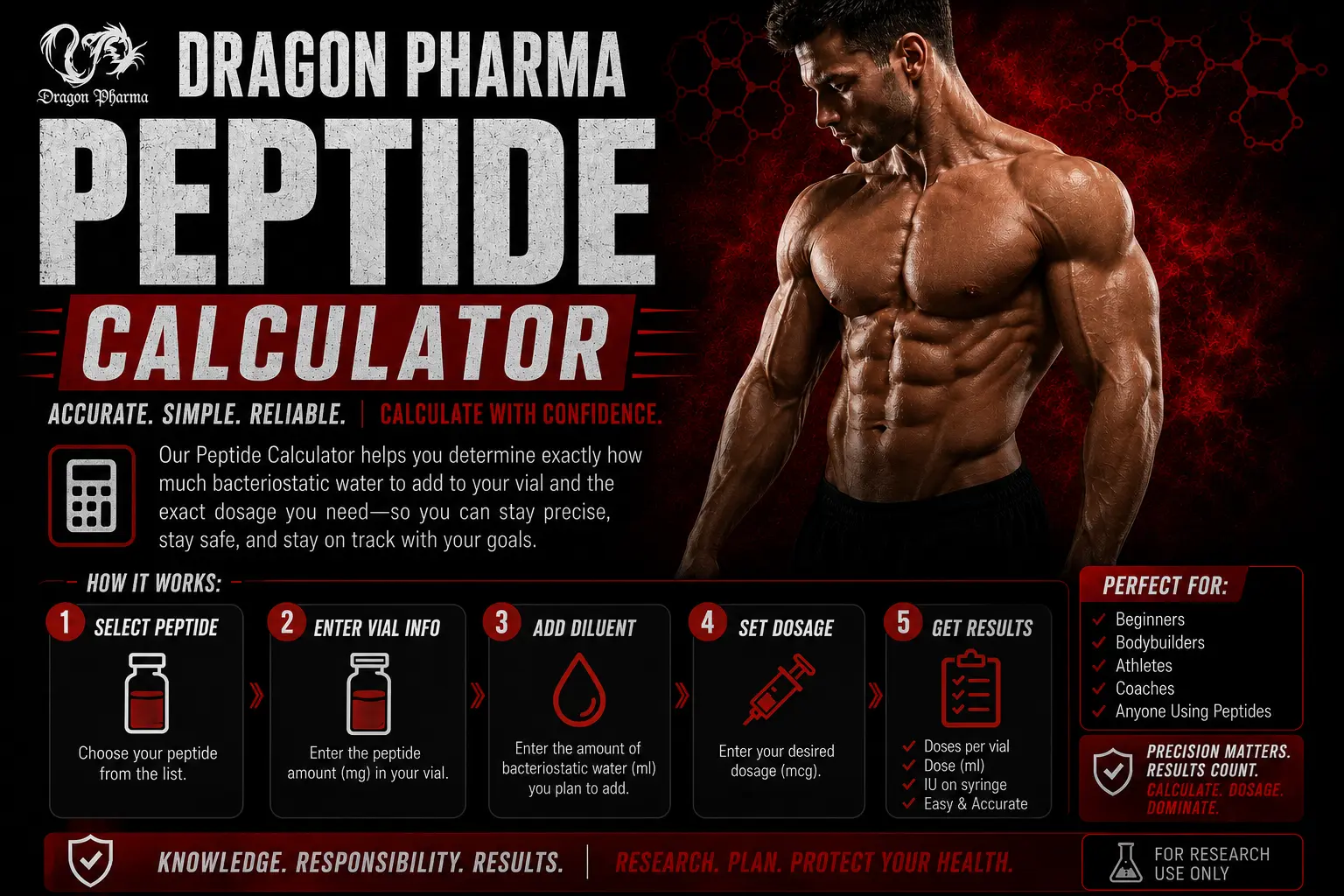
Calculate exactly how many insulin syringe units to draw.
Prescribed peptide dose
Total peptide inside the vial
Amount added to the vial
Show Calculation
Units = (Water ÷ Strength) × (Dose × 100)
Peptide Calculator
Calculate peptide dosage, reconstitution volume, concentration, and syringe units instantly with our advanced peptide calculator. Enter your peptide vial strength, bacteriostatic water (BAC water) volume, and desired dose to accurately determine the calculated amount based on your input values.
Whether calculating a 2mg, 5mg, 10mg, 15mg, or 30mg peptide vial, this peptide dosage calculator helps simplify conversions between milligrams (mg), micrograms (mcg), milliliters (mL), and U-100 insulin syringe units.
How the Peptide Calculator Works
The peptide reconstitution calculator uses standard concentration formulas to determine the relationship between peptide amount and dilution volume.
Peptide Concentration = Total Peptide Amount ÷ Dilution Volume
After determining the final concentration, the calculator converts the desired amount into the corresponding liquid volume:
Draw Volume (mL) = Desired Dose ÷ Peptide Concentration
For U-100 insulin syringes:
- 1 unit = 0.01mL
This allows users to quickly convert calculated volumes into syringe units.
Peptide Reconstitution Calculator
Peptide reconstitution is the process of combining a lyophilized (freeze-dried) peptide powder with a liquid diluent such as bacteriostatic water to create a measurable solution.
The amount of BAC water added determines the final concentration. A smaller dilution volume creates a more concentrated solution, while a larger dilution volume creates a lower concentration that may allow easier measurement.
Common Examples
- 5mg peptide vial + 2mL bacteriostatic water = 2.5mg/mL concentration
- 10mg peptide vial + 2mL bacteriostatic water = 5mg/mL concentration
- 2mg peptide vial + 1mL bacteriostatic water = 2mg/mL concentration
Use the calculator above to perform custom peptide dilution calculations based on your entered vial strength and liquid volume.
Convert Peptide Dose From mg to mcg
A common peptide calculation error is confusing milligrams and micrograms. The conversion between these units is:
1mg = 1,000mcg
Examples
- 0.25mg = 250mcg
- 0.5mg = 500mcg
- 1mg = 1,000mcg
The peptide calculator automatically performs these conversions to reduce manual calculation mistakes.
Peptide Syringe Unit Calculator
Many peptide calculations use U-100 insulin syringes because they provide precise volume measurements.
A U-100 syringe measurement:
- 1 unit = 0.01mL
- 10 units = 0.1mL
- 50 units = 0.5mL
- 100 units = 1mL
The calculator converts the calculated peptide volume into syringe units for easier measurement reference.
Always confirm the syringe type before calculations, as U-40 and U-100 syringes use different measurement systems.
Compatible Peptides
This calculator can be used for concentration and volume calculations across many research peptides, including:
- Semaglutide
- Tirzepatide
- Retatrutide
- Cagrilintide
- BPC-157
- TB-500
- CJC-1295
- Ipamorelin
- Tesamorelin
- GHK-Cu
- MOTS-c
- AOD-9604
The calculator performs mathematical conversions based on entered values and does not determine recommended doses or treatment protocols.
BAC Water Mixing Calculator
Bacteriostatic water volume directly affects the final peptide concentration. Important calculation factors include:
- Peptide vial strength
- Amount of BAC water added
- Desired peptide amount
- Syringe type
- Final solution concentration
Accurate measurements are important because dilution changes affect the concentration of future calculations.
Common Peptide Calculation Mistakes
Confusing mg and mcgA 1mg amount equals 1,000mcg. Always confirm measurement units before performing calculations.
Using the Wrong Syringe ScaleU-100 and U-40 syringes use different measurement systems and should not be interchanged during calculations.
Incorrect Dilution CalculationsThe amount of bacteriostatic water added changes the final concentration of the peptide solution.
Rounding Too EarlyPremature rounding can create inaccurate results, especially when working with small measurement values.
Peptide Storage and Handling
Proper peptide handling helps maintain sample stability and consistency. General storage considerations include:
- Protecting peptides from excessive heat and light
- Avoiding unnecessary freeze-thaw cycles
- Maintaining suitable storage conditions
- Handling reconstituted solutions carefully
Always follow manufacturer instructions and applicable research guidelines for storage and handling.
Why Use a Dedicated Peptide Calculator?
Manual peptide calculations require multiple conversions between:
- mg
- mcg
- mL
- Concentration
- Syringe units
A dedicated peptide calculator combines these mathematical steps into one simple tool, helping reduce calculation errors and providing fast conversion results.
Frequently Asked Questions
How accurate is the peptide calculator?
The calculator performs mathematical conversions based on the information entered. Accuracy depends on entering the correct peptide amount, dilution volume, and desired calculation values.
How do I calculate peptide syringe units?
First determine the peptide concentration, then convert the required volume into syringe units. A U-100 syringe contains 100 units per milliliter.
How much BAC water should I add to a peptide vial?
The required amount depends on the desired concentration and vial size. Enter your values into the calculator to determine the resulting concentration.
Can this calculator be used for Semaglutide and Tirzepatide?
Yes. The calculator can perform concentration and volume conversions for peptides and compounds when the vial amount and dilution volume are known.
What is the difference between mg and mcg?
Milligrams and micrograms measure the same type of quantity at different scales. 1mg equals 1,000mcg.