


Selank Peptide: Structure, Mechanism, and Research Findings
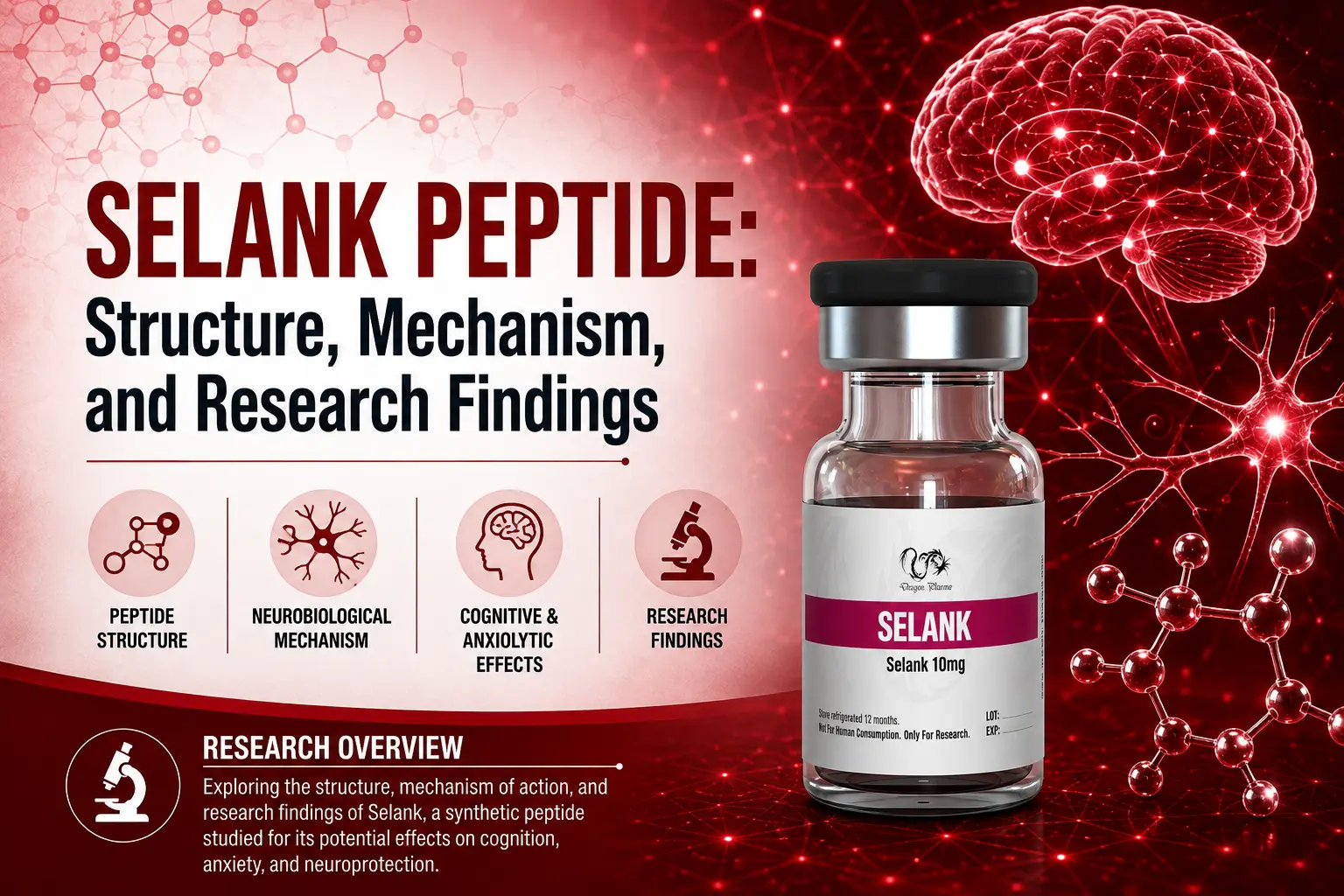
Selank peptide for sale USA is a synthetic heptapeptide structurally derived from the endogenous tetrapeptide Tuftsin, developed in Russia to improve on Tuftsin's metabolic stability and half-life. Selank is a registered anxiolytic pharmaceutical in Russia (not FDA-approved in the United States), which is part of why genuine human clinical trial data exists for this compound — though two of its clinical studies are described in secondary sources as testing "experimental models" rather than the anxiety-disorder patients they actually involved. This article covers Selank's mechanism, gene-expression and neurotransmitter research, and corrects that framing.
Table of Contents
- Key Facts at a Glance
- Structure and Development
- Mechanism of Action
- GABAergic Modulation (Rat and Human Cell Data)
- BDNF Modulation
- Serotonergic Activity
- Cognitive Function Research
- Gene Expression and Inflammatory Signaling
- Enkephalin Pathways: Human Clinical Data
- Immune Regulation: Human Clinical Data
- Cardiovascular Dynamics (Feline Model)
- Withdrawal-Related Responses
- Lipid Metabolism Research
- Evidence Summary by Study
- Storage and Stability
- Frequently Asked Questions
- Key Takeaways
- References
Key Facts at a Glance
| Property | Detail |
|---|---|
| Structure | Heptapeptide: Tuftsin fragment (N-terminus) + Pro-Gly-Pro (PGP) motif (C-terminus) |
| Parent compound | Tuftsin (endogenous tetrapeptide) |
| Regulatory status | Registered anxiolytic pharmaceutical in Russia; not FDA-approved in the United States |
| Proposed mechanisms | GABAergic transcriptional modulation, BDNF upregulation, serotonergic metabolism, enkephalin preservation, immunomodulation |
| Evidence type | Rat/rodent studies, one feline cardiovascular study, one human in vitro cell-line study, and two human clinical trials in anxiety-disorder patients |
Structure and Development
Selank combines the Tuftsin fragment at its N-terminus with a Pro-Gly-Pro (PGP) motif at its C-terminus, a design intended to improve metabolic stability and prolong half-life relative to native Tuftsin.
The PGP sequence is suggested to influence the peptide's physiochemical interaction with lipid-rich biological membranes. Research suggests Selank may exert modulatory effects on immunological processes, with potential interactions involving T helper cells and IL-6 signaling.
Mechanism of Action
Selank's proposed mechanism spans monoamine neurotransmitter modulation, BDNF regulation, blood-brain barrier transit via the PGP motif, and Tuftsin-derived immunomodulatory activity.
The peptide may influence monoamine neurotransmitter systems and contribute to BDNF regulation, suggesting a neurotrophic/neuro-regulatory role. The PGP motif is thought to facilitate blood-brain barrier transit, potentially via interaction with transport systems or receptors enabling receptor-mediated endocytosis or active transport; structural features of Selank's tertiary conformation may further support BBB compatibility. Selank's immunomodulatory properties, inferred from its Tuftsin component, might influence phagocytic activity, cell motility, and other immune cell functions — though the specific supporting citation for this immune claim in the source material was actually about an unrelated GABA gene-expression study; see the GABAergic Modulation section below for what that source actually demonstrates.
GABAergic Modulation
Both rat administration studies and a human neuroblastoma cell-line study have examined Selank's effects on GABA-related gene expression.
A study in rats examined expression of 84 genes linked to neurotransmission following exposure to Selank or GABA, finding a positive correlation between gene expression patterns — suggesting Selank may modulate the GABAergic system indirectly through transcriptional regulation rather than direct receptor activation alone. Distinct variations in specific gene expression relative to GABA further suggest possible allosteric or modulatory mechanisms [3].
Separately, a study using IMR-32 human neuroblastoma cells (in vitro) compared GABA, Selank, and olanzapine effects on GABAergic neurotransmission gene expression [2] — a human cell-line data point that adds some translational relevance beyond the rat findings, though it remains in vitro evidence.
Additional studies suggest Selank may alter GABA receptor functional properties, potentially modifying receptor affinity and supporting inhibitory signaling, in a manner described as synergistic with benzodiazepines but without their typical dependence/amnestic profile. Preclinical reports also suggest Selank may influence enzymatic pathways involved in enkephalin degradation, indirectly affecting GABAergic tone by preserving endogenous anxiolytic peptides.
BDNF Modulation
Rat studies suggest Selank may increase BDNF mRNA levels in the hippocampus, a region associated with memory processing and emotional regulation, particularly relevant under conditions where stress or elevated glucocorticoids suppress BDNF expression — suggesting a possible role in supporting neuroplasticity and adaptive synaptic function [3].
Serotonergic Activity
Rodent model data suggests Selank may interact with serotonergic pathways implicated in mood and anxiety regulation. In models with experimentally reduced serotonin synthesis, Selank exposure appeared to modulate serotonin metabolism in brainstem regions, potentially counteracting diminished serotonergic activity.
Cognitive Function Research
In rats trained on a conditioned avoidance response (CAR) paradigm over four consecutive days, Selank exposure prior to training correlated with improved performance (fewer errors, more correct responses). The study authors noted that "Selank caused a number of alterations in the expression of genes involved in neurotransmission... one of its possible molecular mechanisms is associated with allosteric modulation of the GABAergic system" [3]. Selank may also modulate neural circuits associated with memory consolidation and support learning outcomes partly by mitigating anxiety-related interference with cognitive performance.
Gene Expression and Inflammatory Signaling
A study in male rats assigned to control, single-exposure, and repeated-exposure Selank groups analyzed spleen and hippocampal RNA via PCR. Selank exposure was associated with modulated gene expression in both tissues, with alterations in CX3CR1 (a gene implicated in inflammatory pathways) suggesting Selank may influence inflammatory signaling through transcriptional regulation — pointing to a possible immunomodulatory mechanism at the genomic level [4].
Enkephalin Pathways: Human Clinical Data
This is human clinical trial data — published under the title "...therapy of generalized anxiety disorders and neurasthenia" — not an animal "experimental model" study as vaguer framing elsewhere suggests.
Zozulia et al. (2008) examined Selank's interaction with enkephalin signaling in human patients with generalized anxiety disorder. Selank administration appeared to modulate levels of tau-Leu-enkephalins, endogenous opioid peptides involved in mood, stress, and pain regulation. Selank is hypothesized to suppress enzymatic enkephalin degradation, potentially elevating enkephalin half-life and availability — proposed as a mechanism contributing to anxiolytic effects, discussed as a possible complementary or alternative route to benzodiazepine-based approaches [5].
Immune Regulation: Human Clinical Data
This is human clinical trial data — published under the title "...in patients with anxiety-asthenic disorders" — not a generic "experimental model" study.
Uchakina et al. (2008) examined Selank's immunomodulatory effects in human patients with generalized anxiety disorder and neurasthenia features, over a 14-day exposure period. Peripheral blood analysis found transient IL-6 elevations alongside shifts in the Th1/Th2 cytokine ratio, suggesting Selank may influence the balance of pro- and anti-inflammatory signaling in these patients [6].
Cardiovascular Dynamics (Feline Model)
In cats, Selank exposure was associated with a rapid arterial blood pressure reduction exceeding 30% within the first three minutes, and cerebral blood flow increases exceeding 20% during the first 10 minutes, gradually returning to baseline. No significant heart rate or respiratory changes were observed, suggesting selective influence on vascular tone and cerebral perfusion without generalized cardiovascular or respiratory effects [7].
Withdrawal-Related Responses
In rats subjected to chronic ethanol exposure followed by abrupt cessation, Selank was reported by researchers as "possibly effective in eliminating alcohol withdrawal symptoms." Social interaction and maze-task measures suggested reduced withdrawal-associated anxiety and cognitive disruption, suggesting Selank may influence neural circuits implicated in stress and reward processing [8].
Lipid Metabolism Research
In rodents fed a high-fat diet for six weeks, Selank exposure was associated with reductions in total cholesterol, LDL, VLDL, triglycerides, and overall fat content (roughly 25% to over 50% decreases), alongside increased fibrinolytic activity, reduced platelet aggregation, and stabilized blood glucose. The Selank group maintained or gradually reduced body weight, while the control group gained an average of 40g over the study period [9].
Evidence Summary by Study
| Research Finding | Model | Evidence Tier |
|---|---|---|
| GABAergic gene expression (84-gene panel) | Rats | Animal |
| GABAergic gene expression (GABA/Selank/olanzapine) | IMR-32 human neuroblastoma cells | In vitro (human cell line) |
| BDNF hippocampal upregulation | Rats | Animal |
| Cognitive/CAR performance | Rats | Animal |
| Spleen/hippocampus gene expression, CX3CR1 | Rats | Animal |
| Enkephalin pathway modulation | Human patients, GAD/neurasthenia | Human clinical |
| IL-6, Th1/Th2 immune modulation | Human patients, anxiety-asthenic disorders | Human clinical |
| Blood pressure, cerebral blood flow | Cats | Animal |
| Alcohol withdrawal symptom reduction | Rats | Animal |
| Lipid profile, hemostasis, glucose | Rodents (high-fat diet model) | Animal |
Storage and Stability
| Condition | Recommendation |
|---|---|
| Lyophilized form | Store frozen (-20°C) for long-term stability |
| Reconstituted solution | Refrigerate (2–8°C); use within the research protocol's defined window |
| Light exposure | Store protected from light |
| Handling | Avoid repeated freeze-thaw cycles to preserve peptide integrity |
Frequently Asked Questions
What is Selank?
Selank is a synthetic heptapeptide derived from Tuftsin, combining the Tuftsin fragment with a Pro-Gly-Pro motif, studied primarily for anxiolytic, neurotrophic, and immunomodulatory effects.
Is Selank an approved medication anywhere?
Yes, Selank is a registered anxiolytic pharmaceutical in Russia, though it is not FDA-approved in the United States.
Has Selank been tested in human clinical trials?
Yes. Two Russian clinical studies examined Selank in human patients with generalized anxiety disorder and related conditions, evaluating enkephalin pathway effects and immune/cytokine changes.
How does Selank affect GABA signaling?
Research in rats and in human neuroblastoma cells suggests Selank may modulate GABAergic gene expression and receptor function, potentially acting as an indirect, transcription-based modulator rather than a direct receptor agonist.
Does Selank affect BDNF?
Rat studies suggest Selank may increase hippocampal BDNF mRNA levels, particularly relevant under stress conditions that typically suppress BDNF expression.
Does Selank affect the immune system?
A human clinical study in patients with anxiety-asthenic disorders found transient IL-6 elevations and shifts in the Th1/Th2 cytokine ratio following Selank exposure, alongside animal gene-expression research on inflammatory pathway genes like CX3CR1.
Has Selank been studied for alcohol withdrawal?
A rat study found Selank exposure was associated with reduced withdrawal-related anxiety and cognitive disruption following chronic ethanol exposure and abrupt cessation.
Does Selank affect cardiovascular function?
A feline study found Selank produced rapid arterial blood pressure reduction and increased cerebral blood flow without significant heart rate or respiratory changes, suggesting selective vascular effects.
Does Selank affect lipid metabolism?
A rodent high-fat-diet study found Selank exposure associated with reduced cholesterol, LDL, VLDL, triglycerides, and body weight gain relative to controls.
Key Takeaways
- Selank is a Tuftsin-derived heptapeptide and a registered anxiolytic pharmaceutical in Russia, which underpins its unusually substantial human clinical trial history for a research peptide.
- Two human clinical studies — in GAD/neurasthenia and anxiety-asthenic disorder patients — were found describing subjects as generic "experimental models" rather than the patients they actually involved; this has been corrected.
- Proposed mechanisms span GABAergic transcriptional modulation, BDNF upregulation, serotonergic metabolism, enkephalin preservation, and immunomodulation.
- A citation mismatch was identified: an immune-function claim in the introduction was attached to a study actually about GABAergic gene expression in human neuroblastoma cells; this has been repositioned to the relevant section.
- Evidence spans rat, feline, and human-cell-line studies alongside the two human clinical trials; this article labels each by actual species/population rather than treating all findings as equivalent.
References
- Kozlovskaya MM, Kozlovskii II, Val'dman EA, Seredenin SB. Selank and short peptides of the tuftsin family in the regulation of adaptive behavior in stress. Neurosci Behav Physiol. 2003;33(9):853-60. https://pubmed.ncbi.nlm.nih.gov/14969422/
- Filatova E, et al. GABA, Selank, and Olanzapine Affect the Expression of Genes Involved in GABAergic Neurotransmission in IMR-32 Cells. Front Pharmacol. 2017. https://doi.org/10.3389/fphar.2017.00089
- Volkova A, Shadrina M, Kolomin T, et al. Selank Administration Affects the Expression of Some Genes Involved in GABAergic Neurotransmission. Front Pharmacol. 2016;7:31. https://www.ncbi.nlm.nih.gov/pmc/articles/PMC4757669/
- Kolomin TA, et al. Transcriptomic Response of Rat Hippocampus and Spleen Cells to Single and Chronic Administration of the Peptide Selank. 2009. https://doi.org/10.1134/S1607672910010023
- Zozulia AA, Neznamov GG, Siuniakov TS, et al. Efficacy and possible mechanisms of action of a new peptide anxiolytic selank in the therapy of generalized anxiety disorders and neurasthenia. Zh Nevrol Psikhiatr Im S S Korsakova. 2008;108(4):38-48. https://pubmed.ncbi.nlm.nih.gov/18454096/
- Uchakina ON, Uchakin PN, Miasoedov NF, et al. Immunomodulatory effects of selank in patients with anxiety-asthenic disorders. Zh Nevrol Psikhiatr Im S S Korsakova. 2008;108(5):71-5. https://pubmed.ncbi.nlm.nih.gov/18577961/
- Gan'shina TS, Kozlovskii II. Effects of the new peptide anxiolytic drug selank on the cardiovascular system functioning and respiration in cats. Eksp Klin Farmakol. 2005;68(4):33-5. https://pubmed.ncbi.nlm.nih.gov/16193654/
- Kolik LG, Nadorova AV, Kozlovskaya MM. Efficacy of peptide anxiolytic selank during modeling of withdrawal syndrome in rats with stable alcoholic motivation. Bull Exp Biol Med. 2014;157(1):52-5. https://pubmed.ncbi.nlm.nih.gov/24913576/
- Mjasoedov NF, et al. The Influence of Selank on the Parameters of the Hemostasis System, Lipid Profile, and Blood Sugar Level in the Course of Experimental Metabolic Syndrome. 2014. https://pubmed.ncbi.nlm.nih.gov/25371249/
Articles
This article covers its structure, mechanism, and research findings — including human clinical trial data, GHRH-knockout mouse research, and corrections to two citation issues found in the source material, one involving a duplicated/misattached reference and one involving a pharmacokinetic claim sourced to a study that isn't actually a pharmacology paper.
What is Post Cycle Therapy and how to do it after each steroid cycle.

If you are looking to buy Dragon Pharma with bitcoins then you found the right place.
Customer Reviews
Please leave your review on products or service below.
Thank you beforehand.
- ordered more than 10 orders from this site, thanks for Lab test section, good work, will buy again. thanks
- Make it easier to find specific compounds regardless of manufacturer.