


CJC-1295 DAC: Structure, Mechanism, and Research Findings
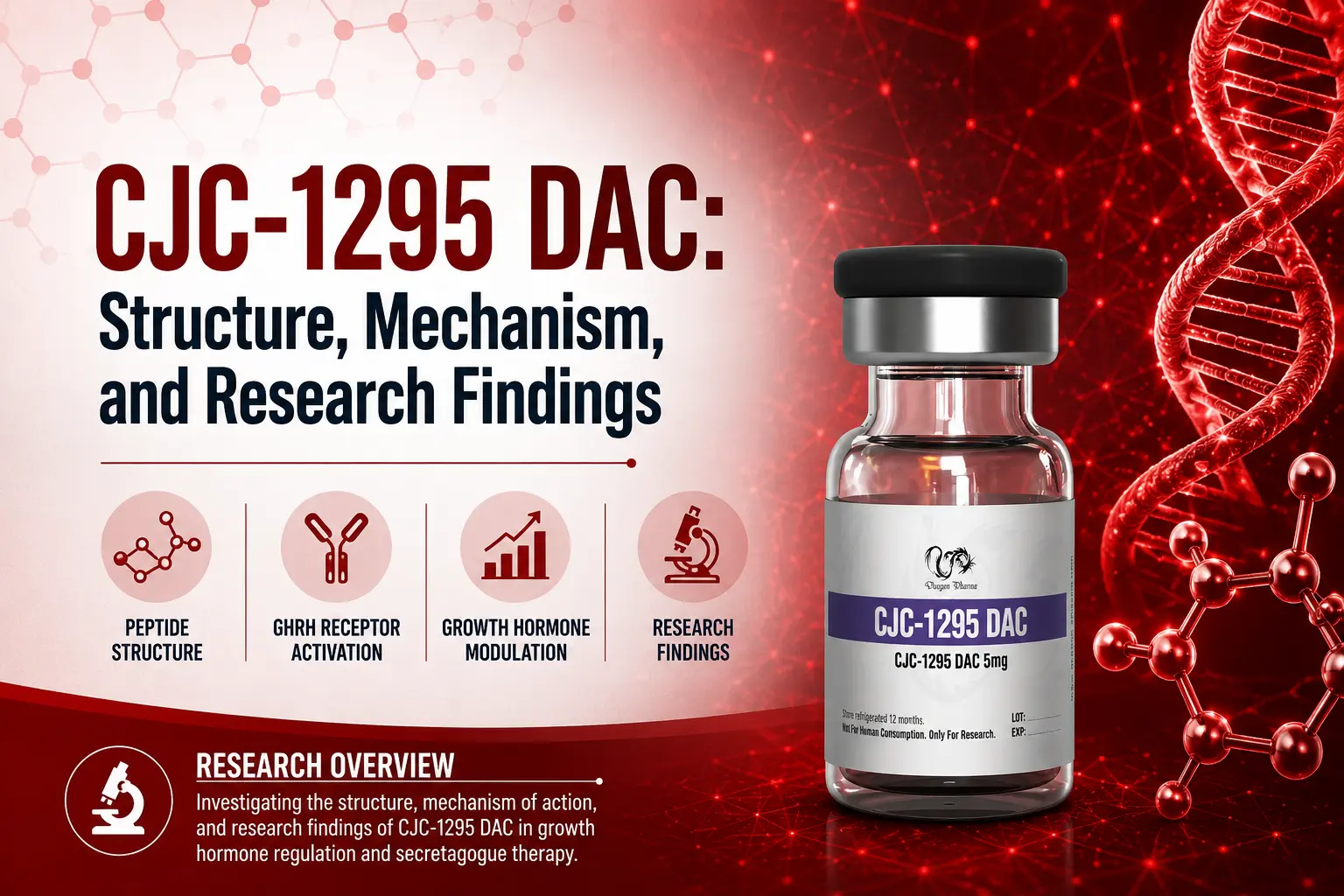
CJC-1295 DAC is a synthetic 29-amino-acid, long-acting GHRH analog incorporating a Drug Affinity Complex (DAC) that enables covalent attachment to serum albumin, extending its biological half-life from minutes to roughly 6–8 days. This article covers its structure, mechanism, and research findings — including human clinical trial data, GHRH-knockout mouse research, and corrections to two citation issues found in the source material, one involving a duplicated/misattached reference and one involving a pharmacokinetic claim sourced to a study that isn't actually a pharmacology paper. Buy CJC-1295 DAC Online for continued laboratory investigation.

Table of Contents
- Key Facts at a Glance
- Structure and Development
- CJC-1295 DAC vs. CJC-1295 Without DAC (Modified GRF 1-29)
- Mechanism of Action
- Human Endocrine Activity: 2006 Clinical Studies
- GH Pulsatility and Receptor Pathway Activation
- Preclinical Research in GHRH-Deficient Mice
- Discontinued Trial: HIV-Associated Visceral Adiposity
- Pharmacokinetic Modifications and Half-Life (Citation Issue)
- Evidence Summary by Study
- Storage and Stability
- Frequently Asked Questions
- Key Takeaways
- References
Key Facts at a Glance
| Property | Detail |
|---|---|
| Structure | 29-amino-acid tetrasubstituted GHRH analog + DAC (Drug Affinity Complex) moiety |
| Substitutions | Positions 2 (D-Ala), 8 (Gln), 15 (Ala), 27 (Leu) |
| Developer | ConjuChem (Canada), mid-2000s |
| Receptor target | GHRH receptor, anterior pituitary somatotrophs |
| Reported half-life | ~6–8 days (vs. ~7 min for endogenous GHRH; ~30 min for CJC-1295 without DAC) |
| Evidence type | Human clinical trials (healthy adults), GHRH-knockout mouse studies, one discontinued human trial |
Structure and Development
CJC-1295 DAC is a tetrasubstituted 29-amino-acid GHRH analog developed by ConjuChem in the mid-2000s, engineered for both receptor binding affinity and extended plasma stability.
The DAC (Drug Affinity Complex) component is a lysine-linked derivative of N-ε-3-maleimidopropionamide, enabling covalent attachment to plasma proteins such as serum albumin. This is recognized as the shortest functional GHRH analog capable of inducing GH release while maintaining high receptor affinity and markedly improved pharmacokinetic stability relative to shorter GHRH fragments or non-DAC counterparts.
CJC-1295 DAC vs. CJC-1295 Without DAC (Modified GRF 1-29)
These are genuinely different pharmacokinetic profiles, not just naming variants — a distinction we've had to correct in other articles where it was blurred, but which is accurately drawn here.
| Form | Half-Life | Key Feature |
|---|---|---|
| Endogenous GHRH | ~7 minutes | Rapid enzymatic degradation |
| CJC-1295 without DAC (Modified GRF 1-29) | ~30 minutes | Tetra-substituted backbone only, no albumin conjugation |
| CJC-1295 DAC | ~6–8 days | Same backbone + DAC moiety for reversible albumin binding |
For more detail on how this naming distinction is commonly blurred in secondary sources, see our companion articles on the Tesamorelin/Modified GRF 1-29/Ipamorelin blend and the Modified GRF 1-29/GHRP-2 blend.
Mechanism of Action
CJC-1295 DAC binds GHRH receptors on somatotrophs, triggering cAMP/PKA signaling that promotes GH gene transcription and pulsatile GH release, with the DAC moiety creating a slow-release albumin-bound depot.
Receptor binding initiates cAMP-dependent intracellular signaling, potentially activating PKA and supporting transcription of GH-encoding genes and exocytotic release of stored GH vesicles. Because GH secretion normally occurs in pulsatile bursts governed by GHRH/somatostatin interplay, research suggests CJC-1295 DAC may reinforce these pulses by amplifying the stimulatory phase while the endogenous inhibitory rhythm remains intact [3]. The DAC-mediated plasma protein binding is proposed to create a slow-release depot enabling sustained receptor activation without overstimulation.
Research also suggests CJC-1295 DAC may act synergistically with ghrelin mimetics such as GHRP-6 or Hexarelin, which act on separate ghrelin receptors to suppress somatostatin and support GHRH-driven GH release — a dual-pathway interaction that might potentiate hepatic IGF-1 synthesis and downstream anabolic/lipolytic signaling.
Human Endocrine Activity: 2006 Clinical Studies
This is human clinical trial data — Teichman et al. (2006), published under the title "...in healthy adults" — not a generic "baseline model" study as the vaguer phrasing in some secondary sources suggests.
Two controlled clinical studies in 2006 examined CJC-1295 DAC's endocrine effects in healthy human adults: a single ascending-dose design and a repeated fixed-dose design. Both were associated with measurable increases in circulating GH and IGF-1 relative to baseline. The observed IGF-1 rise is theorized to result from enhanced GH production activating hepatic GH receptors and the downstream JAK-STAT pathway, where phosphorylated STAT proteins translocate to the nucleus and promote IGF-1 gene transcription.
Exposure was associated with 2- to 10-fold GH elevations persisting up to six days, and 1.5- to 3-fold IGF-1 elevations remaining above baseline for approximately 9–11 days. In the repeated-exposure design, these elevations reportedly persisted up to 28 days, suggesting a possible cumulative effect on the GH-IGF-1 axis across repeated dosing [4].
GH Pulsatility and Receptor Pathway Activation
This study (Ionescu & Frohman, 2006) is very likely also human data, given it was published the same year in the same journal (JCEM) by an overlapping research group studying the same compound — though this should be verified against the full text rather than assumed with complete certainty.
A separate 2006 investigation assessed GH pulsatility following a single peptide introduction, reporting an approximate 50% increase in mean GH secretion and a similar IGF-1 elevation relative to baseline, with peak GH concentrations rising as much as 7.5-fold. Mechanistically, CJC-1295 DAC is believed to engage the GHRH receptor (a GPCR on somatotrophs), activating G-protein subunits and promoting cAMP and IP₃ second-messenger synthesis. These messengers are thought to activate protein kinases that phosphorylate transcription regulators involved in GH gene expression [5][6].
Preclinical Research in GHRH-Deficient Mice
Correction: this section's citation was misattached in the source material to an unrelated sentence about company history; it belongs here, describing GHRH-knockout (GHRHKO) mouse research.
Studies in mice lacking the GHRH gene evaluated CJC-1295 DAC's anabolic potential, comparing daily exposure, intermittent (every 2–3 day) exposure, and placebo. Daily exposure nearly normalized growth profiles in GHRHKO mice, while intermittent exposure produced intermediate effects, suggesting a frequency-dependent response. Treated mice showed increased lean muscle mass preservation and reduced fat accumulation, alongside increased pituitary total RNA and GH mRNA levels, suggesting increased somatotroph cell proliferation. Immunohistochemical analysis supported this, showing increased somatotroph density in the anterior pituitary following exposure [2].
Discontinued Trial: HIV-Associated Visceral Adiposity
A 2005 clinical trial (ClinicalTrials.gov NCT00267527) was designed to examine CJC-1295 DAC's endocrine and metabolic activity in HIV-associated visceral adiposity, planned as three months of exposure followed by a six-week observational phase. This trial was discontinued during the recruitment phase, and no validated findings or results were reported [8].
Pharmacokinetic Modifications and Half-Life (Citation Issue)
Important: the source material cites a netnography study (a qualitative analysis of online forum discussions among recreational users) as the source for the specific "6–8 day half-life" figure. That paper is social-science research about use patterns and online discourse, not a pharmacokinetic study, and cannot properly support a specific half-life claim. This figure should not be published without locating an actual pharmacokinetic source.
The structural basis for CJC-1295 DAC's extended half-life is well-supported: four amino acid substitutions (position 2, L-Ala→D-Ala, supporting DPP-IV resistance; position 8, Asn→Gln, reducing deamidation susceptibility; position 15, Gly→Ala, supporting receptor binding; position 27, Met→Leu, reducing oxidative degradation) combine with the DAC moiety's reversible albumin binding to create a proposed slow-release mechanism. The specific numeric half-life estimate of 6–8 days, however, needs a properly sourced pharmacokinetic citation rather than the social-science reference currently associated with it.
Evidence Summary by Study
| Research Finding | Model | Evidence Tier |
|---|---|---|
| GH/IGF-1 elevation, ascending and repeated dose | Healthy human adults | Human clinical |
| GH pulsatility, receptor pathway activation | Likely human (same program/year); not fully confirmed | Probable human clinical — verify |
| Growth normalization, somatotroph proliferation | GHRH-knockout mice | Animal |
| HIV-associated visceral adiposity | Human (trial discontinued, no data) | No valid data available |
| 6–8 day half-life figure | N/A | Miscited — sourced to a non-pharmacokinetic study |
Storage and Stability
| Condition | Recommendation |
|---|---|
| Lyophilized form | Store frozen (-20°C) for long-term stability |
| Reconstituted solution | Refrigerate (2–8°C); use within the research protocol's defined window |
| Light exposure | Store protected from light |
| Handling | Avoid repeated freeze-thaw cycles to preserve peptide integrity |
Frequently Asked Questions
What is CJC-1295 DAC?
CJC-1295 DAC is a long-acting synthetic GHRH analog incorporating a Drug Affinity Complex that binds serum albumin, extending its half-life to roughly 6–8 days compared to minutes for endogenous GHRH.
Is CJC-1295 DAC the same as Modified GRF 1-29?
No. They share the same tetra-substituted structural backbone, but CJC-1295 DAC includes the additional DAC albumin-binding moiety, giving it a half-life of days rather than the roughly 30-minute half-life of the non-DAC form.
Has CJC-1295 DAC been tested in humans?
Yes. Controlled studies in healthy human adults found sustained GH and IGF-1 elevations following both single ascending-dose and repeated fixed-dose exposure.
What receptor does CJC-1295 DAC target?
It binds the GHRH receptor, a G-protein-coupled receptor on anterior pituitary somatotroph cells, activating cAMP/PKA signaling that supports GH gene transcription and release.
Has CJC-1295 DAC been studied in animal models?
Yes. Studies in GHRH-knockout mice found daily exposure nearly normalized growth profiles, with increased lean mass preservation, reduced fat accumulation, and increased somatotroph cell proliferation.
Was CJC-1295 DAC studied for HIV-associated fat redistribution?
A trial was planned for this indication but was discontinued during recruitment, and no validated results were ever reported.
What is the actual evidence for CJC-1295 DAC's half-life?
The commonly cited 6–8 day figure is frequently attributed to a study that is actually a qualitative social-science analysis of online forum discussions, not a pharmacokinetic study — this article flags that mismatch and recommends sourcing this specific figure to genuine pharmacology literature.
Does CJC-1295 DAC work with ghrelin-mimetic peptides?
Research suggests it may act synergistically with ghrelin mimetics like GHRP-6 or Hexarelin, which suppress somatostatin via a separate receptor pathway, potentially potentiating combined GH and IGF-1 output.
Why was CJC-1295 developed with a DAC moiety?
The DAC moiety enables reversible covalent binding to serum albumin, creating a slow-release depot that extends the peptide's functional half-life from minutes to days without requiring frequent re-dosing.
Key Takeaways
- CJC-1295 DAC is a tetrasubstituted GHRH analog with a Drug Affinity Complex moiety, extending its half-life from minutes to roughly 6–8 days via reversible albumin binding.
- Human clinical trials in healthy adults found sustained, dose-dependent GH and IGF-1 elevations, with effects persisting up to 28 days under repeated dosing.
- GHRH-knockout mouse research found daily exposure nearly normalized growth, with frequency-dependent effects and increased somatotroph cell proliferation.
- A duplicated/misattached citation was corrected: the GHRH-knockout mouse study reference was originally attached to an unrelated company-history sentence.
- A significant citation issue was flagged: the specific 6–8 day half-life figure is commonly attributed to a social-science netnography study rather than a genuine pharmacokinetic source, and should be re-sourced before publication.
References
- Henninge J, Pepaj M, Hullstein I, Hemmersbach P. Identification of CJC-1295, a growth-hormone-releasing peptide, in an unknown pharmaceutical preparation. Drug Test Anal. 2010;2(11-12):647-50. https://pubmed.ncbi.nlm.nih.gov/21204297/
- Alba M, Fintini D, Sagazio A, et al. Once-daily administration of CJC-1295, a long-acting GHRH analog, normalizes growth in the GHRH knockout mouse. Am J Physiol Endocrinol Metab. 2006;291(6):E1290-4. https://pubmed.ncbi.nlm.nih.gov/16822960/ (Corrected placement; the source material had duplicated this reference and misattached it to an unrelated company-history claim.)
- Sinha DK, Balasubramanian A, Tatem AJ, et al. Beyond the androgen receptor: the role of growth hormone secretagogues in the modern management of body composition in hypogonadal males. Transl Androl Urol. 2020;9(Suppl 2):S149-S159. https://pubmed.ncbi.nlm.nih.gov/32257855/
- Teichman SL, Neale A, Lawrence B, et al. Prolonged stimulation of growth hormone (GH) and IGF-I secretion by CJC-1295, a long-acting analog of GH-releasing hormone, in healthy adults. J Clin Endocrinol Metab. 2006;91(3):799-805. https://pubmed.ncbi.nlm.nih.gov/16352683/
- Ionescu M, Frohman LA. Pulsatile secretion of growth hormone (GH) persists during continuous stimulation by CJC-1295, a long-acting GH-releasing hormone analog. J Clin Endocrinol Metab. 2006;91(12):4792-7. https://pubmed.ncbi.nlm.nih.gov/17018654/
- Newton AC, Bootman MD, Scott JD. Second Messengers. Cold Spring Harb Perspect Biol. 2016;8(8):a005926. https://doi.org/10.1101/cshperspect.a005926
- ClinicalTrials.gov. NCT00267527. US National Institutes of Health. http://clinicaltrials.gov/ct2/show/NCT00267527
- Van Hout MC, Hearne E. Netnography of Female Use of the Synthetic Growth Hormone CJC-1295: Pulses and Potions. Subst Use Misuse. 2016;51(1):73-84. https://pubmed.ncbi.nlm.nih.gov/26771670/ (Qualitative social-science study of online forum discourse; not a pharmacokinetic source. Should not be cited for half-life figures — see correction above.)
Articles
This article covers each component's proposed mechanism and research findings, and flags several citation and terminology issues found in secondary source material on this blend. It is part of the broader peptide research library maintained by Dragon Pharma Peptides.

Best known for its role in skeletal muscle repair, MGF has more recently drawn research interest in neuroscience. This article reviews what transgenic mouse studies have found, the limitations of that evidence, and how MGF compares to related growth factors.
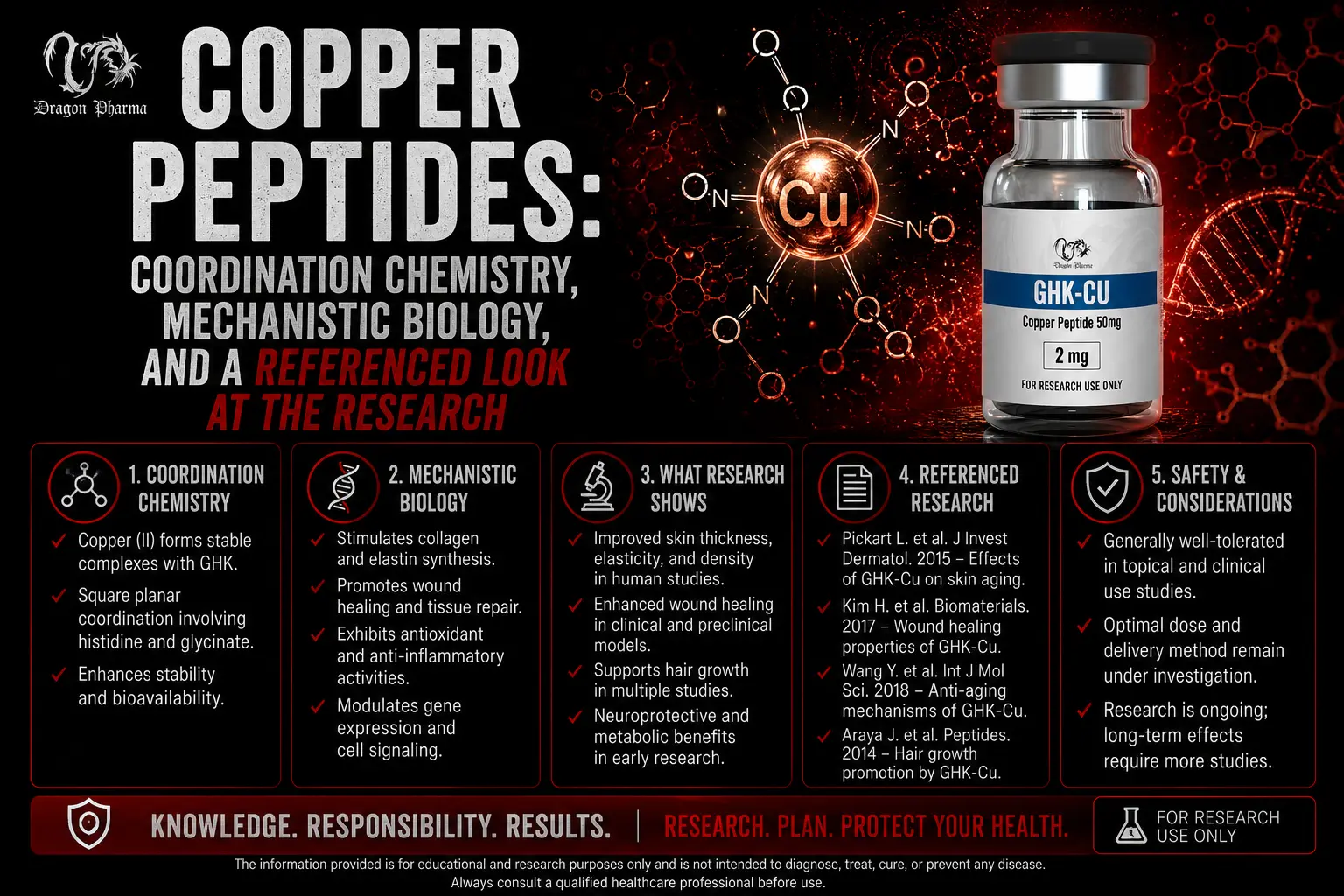
Three members have received the most sustained research attention: GHK-Cu (glycyl-L-histidyl-L-lysine copper(II)), AHK-Cu (alanyl-histidyl-lysine copper(II)), and DAHK-Cu (aspartyl-alanyl-histidyl-lysine copper(II)). Each has a distinct coordination structure, tissue origin, and research focus.
Customer Reviews
Please leave your review on products or service below.
Thank you beforehand.