


Thymosin Alpha-1: Immune Modulation & Antiviral Research Overview
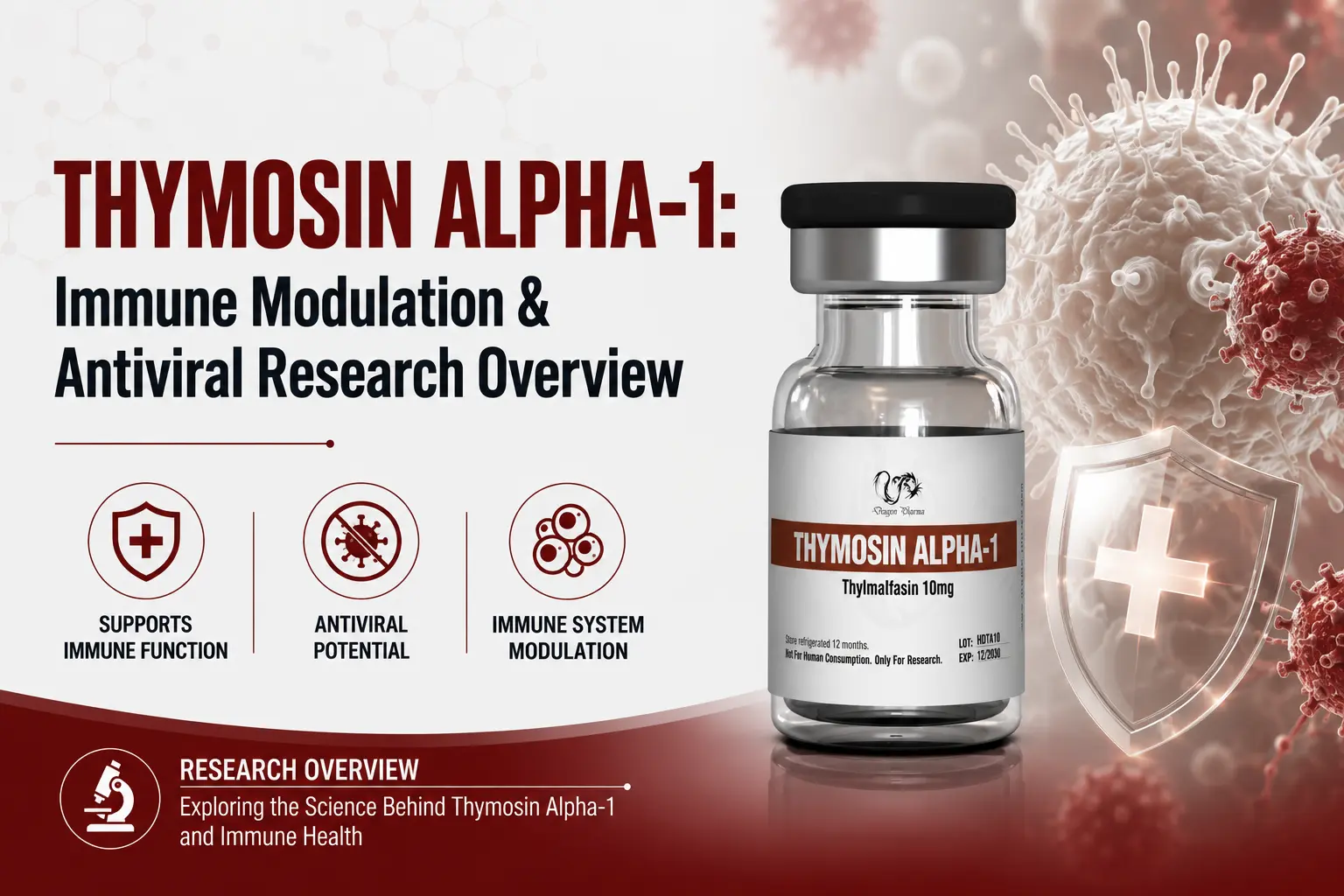
Thymosin Alpha-1 peptide is a naturally occurring thymic peptide studied for its ability to modulate immune cell activity without over-stimulating cytokine production, distinguishing it from agents like interleukin-2 and interferon-alpha. It has been researched across cancer, chronic infection, and immunodeficiency models. This article organizes its proposed mechanisms, immune targets, and evidence base by research category.
Key Facts at a Glance
| Property | Detail |
|---|---|
| Classification | Naturally occurring thymic peptide |
| Primary researched role | Immune modulation, T-cell maturation support |
| Key immune targets | T cells, Natural Killer (NK) cells, dendritic cells, B cells |
| Distinguishing feature | Modulatory rather than over-stimulatory cytokine profile |
| Research areas | Cancer, chronic viral/fungal/bacterial infection, immunocompromised states, vaccination response |
| Clinical use status | Approved as a prescription drug in several countries outside the U.S.; |
| Evidence type | Mixture of in vitro, animal, and human clinical research, varying by application |
What Is Thymosin Alpha-1?
Thymosin Alpha-1 is a peptide derived from the thymus gland's prothymosin alpha protein, researched for its role in coordinating both innate and adaptive immune responses. Unlike broad immune stimulants, it is studied for a more balanced modulatory profile — supporting immune activity where needed without triggering excessive inflammatory signaling.
How Thymosin Alpha-1 Is Proposed to Work
Thymosin Alpha-1's proposed mechanism centers on promoting T-cell maturation and coordinating a multi-cell immune response, rather than acting on a single pathway.
Effects on T-Cell Development and Function
Research suggests Thymosin Alpha-1 may influence:
- Thymocyte maturation — supporting the differentiation of T cells within the thymus
- CD4+ helper and CD8+ cytotoxic T-cell sublineages — influencing how these cells diverge and further mature in peripheral lymphoid tissue
- T-cell mediated cytotoxicity — the capacity of T cells to directly target infected or abnormal cells
- Lymphoproliferative response to mitogens — the degree to which lymphocytes multiply in response to immune triggers
Broader Immune Cell Effects
| Immune Component | Proposed Effect (Research-Based) |
|---|---|
| Natural Killer (NK) cells | Increased activity |
| Cytotoxic T cells | Elevated levels |
| Th1-type cytokines | Increased expression |
| Dendritic cells | Enhanced antigen presentation |
| B cells | Increased antibody production following antigen exposure |
| Regulatory T cells (Tregs) | Promoted in certain models, associated with reduced intestinal inflammation and respiratory allergy response |
Evidence From Immunosuppressed Animal Models
In experiments using thymocytes and mouse models, Thymosin Alpha-1 has been associated with:
- Reduced apoptosis (programmed cell death) of immune cells
- Increased stem cell expansion in immunosuppressed mice
- Elevated production of thymopoietic cytokines, including IL-15, IL-7, and IFN-alpha
Where Thymosin Alpha-1 Has Been Researched
Thymosin Alpha-1 has been studied across several distinct research contexts, each with different evidence maturity.
| Research Context | What's Been Studied | Evidence Level |
|---|---|---|
| Cancer immunology | Coordinated killing of tumor cells via CD8+ Tc1, CD4+ Th1, and NK cell activity; increased tumor antigen expression (beta-2 microglobulin, MHC Class I/II) | Animal and some human clinical research |
| Chronic viral infection | Combination use with IFN-α2b studied in Hepatitis C research models, showing greater normalization of ALT levels and viral RNA clearance versus IFN-α2b alone | Human clinical research (Hepatitis C context) |
| Immunocompromised states / vaccination response | Enhanced antigen presentation via dendritic cells, supporting antibody production after vaccination in immunocompromised models | Animal and preclinical research |
| Respiratory/mucociliary function | Partial restoration of mucociliary clearance and ciliary beating dynamics | Preclinical research |
| Tissue repair | Endothelial cell migration, angiogenesis, and wound healing support | Animal and in vitro research |
| Antioxidant activity | Increased intracellular glutathione, associated with superoxide radical elimination in antioxidant assays | In vitro research |
Thymosin Alpha-1 and Viral Immune Evasion
Research suggests Thymosin Alpha-1 may increase the visibility of virus-infected cells to the immune system by boosting expression of major histocompatibility complex (MHC) molecules. Some viruses employ mechanisms to reduce MHC expression on infected cells, effectively hiding from immune detection. By counteracting this, Thymosin Alpha-1 is theorized to support immune surveillance and potentially limit viral replication — a hypothesis studied primarily in preclinical models.
Thymosin Alpha-1 and ACE Enzyme Interaction
Laboratory data suggests Thymosin Alpha-1 may have inhibitory activity on angiotensin-converting enzyme (ACE), with proposed binding interactions involving hydrogen bonding, hydrophobic forces, and electrostatic interactions. Some research has explored correlations between ACE-inhibitor use and outcomes in viral pneumonia contexts. This remains an area of exploratory research and is not a clinical treatment recommendation; decisions about ACE-inhibitor use in any medical context should only be made by a qualified healthcare provider.
Thymosin Alpha-1 vs. Interferon-Alpha and IL-2: Comparison Table
| Feature | Thymosin Alpha-1 | Interferon-Alpha | Interleukin-2 |
|---|---|---|---|
| Cytokine stimulation profile | Modulatory, not over-stimulatory | Strong pro-inflammatory stimulation | Strong pro-inflammatory stimulation |
| Primary researched targets | T cells, NK cells, dendritic cells | Broad antiviral/immune activation | T-cell proliferation |
| Combination research | Studied alongside IFN-α2b for enhanced effect in Hepatitis C models | Often used as a monotherapy comparator | Used in specific oncology research contexts |
| Reported tolerability in research contexts | Generally favorable relative to comparators | Associated with more pronounced side effects | Associated with more pronounced side effects |
Storage and Stability (Research Use Only)
| Condition | Recommendation |
|---|---|
| Lyophilized form | Store frozen (-20°C) for long-term stability |
| Reconstituted solution | Refrigerate (2–8°C); use within the research protocol's defined window |
| Light exposure | Store protected from light |
| Handling | Avoid repeated freeze-thaw cycles to preserve peptide integrity |
Frequently Asked Questions
What is Thymosin Alpha-1 used for in research?
It is studied for immune modulation across cancer, chronic infection, immunodeficiency, and vaccination-response research models, as well as tissue repair and antioxidant activity.
How is Thymosin Alpha-1 different from interferon-alpha or IL-2?
Research suggests Thymosin Alpha-1 modulates immune activity without triggering the same degree of cytokine over-stimulation associated with interferon-alpha or IL-2.
Does Thymosin Alpha-1 affect T-cell development?
Yes — it is studied for its role in thymocyte maturation and the differentiation of CD4+ helper and CD8+ cytotoxic T-cell sublineages.
What role do Natural Killer cells play in Thymosin Alpha-1 research?
Studies suggest Thymosin Alpha-1 may increase NK cell activity, which contributes to the coordinated immune response against tumors and virus-infected cells.
Has Thymosin Alpha-1 been studied for Hepatitis C?
Yes — human clinical research has evaluated Thymosin Alpha-1 combined with IFN-α2b, reporting greater normalization of liver enzyme (ALT) levels and viral RNA clearance compared to IFN-α2b alone.
Can Thymosin Alpha-1 affect wound healing?
Preclinical and animal research suggests it may support endothelial cell migration and angiogenesis, both relevant to wound-healing processes.
Does Thymosin Alpha-1 have antioxidant properties?
In vitro research indicates it may increase intracellular glutathione levels, which is associated with elimination of superoxide radicals in antioxidant assays.
What is the connection between Thymosin Alpha-1 and viral immune evasion?
Research suggests it may increase MHC molecule expression on infected cells, potentially counteracting viral strategies that reduce immune visibility.
Does Thymosin Alpha-1 affect regulatory T cells?
Some research models suggest it may promote Treg cell activity, associated with reduced intestinal inflammation and respiratory allergy response in those models.
Is there a link between Thymosin Alpha-1 and ACE inhibitors?
Laboratory research suggests Thymosin Alpha-1 may interact with ACE enzyme activity, and some studies have explored this in the context of viral pneumonia outcomes; this is exploratory research, not a treatment guideline.
Key Takeaways
- Thymosin Alpha-1 is a naturally occurring thymic peptide studied for balanced immune modulation across T-cell, NK-cell, and dendritic-cell pathways.
- Its cytokine profile is researched as modulatory rather than over-stimulatory, distinguishing it from agents like interferon-alpha and IL-2.
- Evidence spans in vitro, animal, and human clinical research, with the strongest clinical data existing in chronic viral infection contexts (e.g., Hepatitis C combination studies).
- It is approved as a prescription drug in some countries outside the U.S.
- Additional researched effects include tissue repair, antioxidant activity, and interactions with ACE enzyme signaling — the latter remaining exploratory.
- Dragon Pharma research-grade Thymosin Alpha-1 is intended exclusively for laboratory and scientific research.
Articles

This article clarifies that relationship and organizes what's known about its proposed mechanism, evidence quality, and secondary research areas in cardiovascular and joint health.
Best known for its role in skeletal muscle repair, MGF has more recently drawn research interest in neuroscience. This article reviews what transgenic mouse studies have found, the limitations of that evidence, and how MGF compares to related growth factors.

If you are looking to buy Dragon Pharma with bitcoins then you found the right place.
Customer Reviews
Please leave your review on products or service below.
Thank you beforehand.