


Tesamorelin GHRH Analog: Mechanism and Metabolic Research
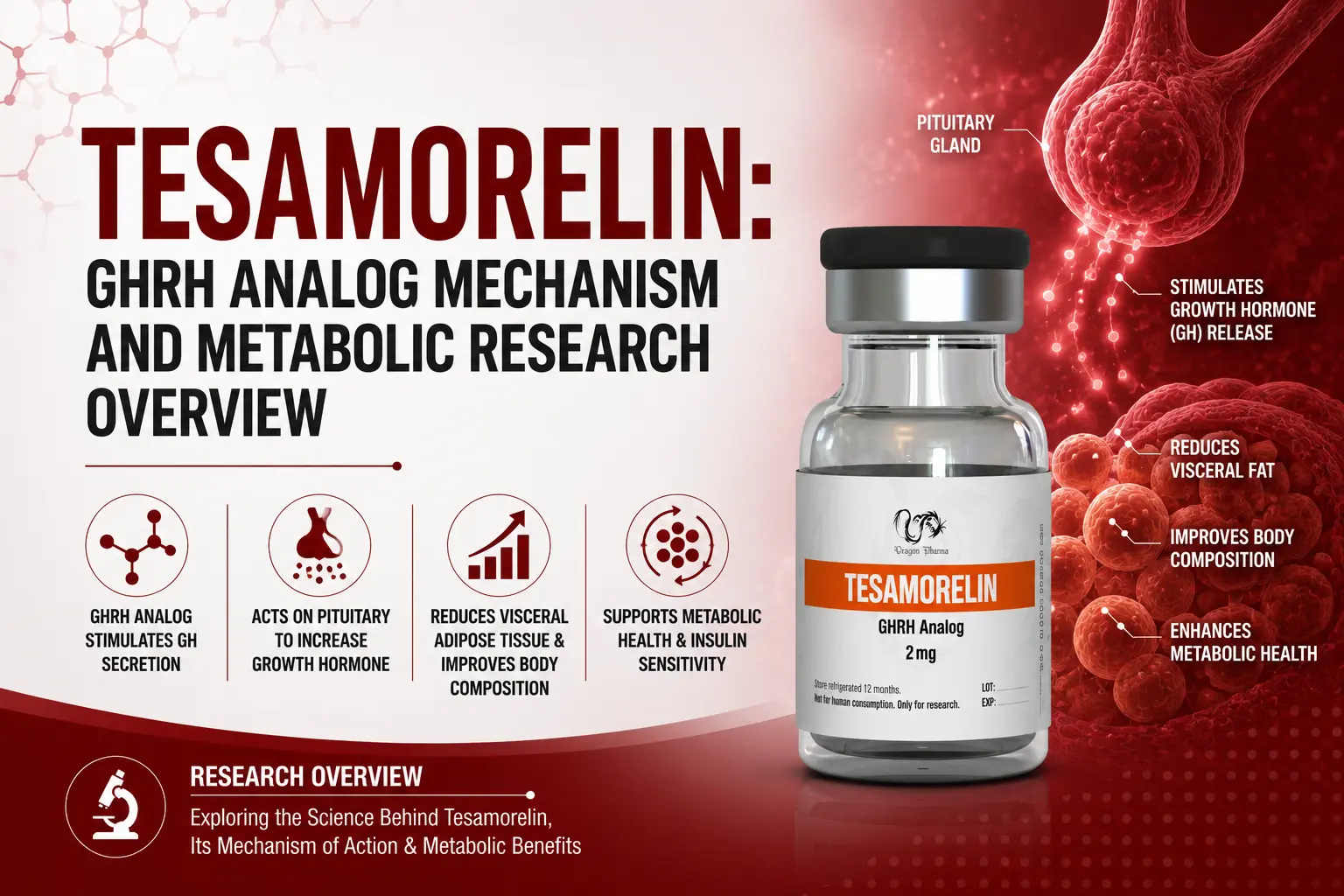
Tesamorelin is a synthetic analogue of endogenous growth hormone-releasing hormone (GHRH) structurally modified to resist enzymatic degradation while preserving receptor binding activity. It is distinguished from most research peptides by an unusually strong human clinical trial record, including multiple Phase III studies. This article organizes its molecular identity, proposed mechanism, and clinical research findings, with direct links to the primary literature, as part of the broader peptide research library maintained by Dragon-Peptides.
Key Facts at a Glance
| Property | Detail |
|---|---|
| Classification | Synthetic GHRH analogue |
| Chemical designation | N-(trans-3-hexenoyl)-[Tyr¹]hGRF(1–44)NH₂ acetate |
| Sequence length | 44 amino acids |
| Molecular weight | ~5,136 Da |
| Former development name | TH9507 |
| Primary receptor target | GHRH receptor (GPCR) on anterior pituitary somatotrophs |
| Regulatory status | FDA-approved under the brand name Egrifta for reduction of excess abdominal fat in HIV-associated lipodystrophy (2010) |
| Evidence type | Multiple randomized, double-blind, placebo-controlled human clinical trials |
What Is Tesamorelin?
Tesamorelin is a 44-amino-acid peptide engineered from the native GHRH(1–44) sequence, with targeted modifications designed to improve metabolic stability without sacrificing receptor activity.
The N-terminal modification adds a trans-3-hexenoic acid moiety, while C-terminal amidation is thought to confer resistance to enzymatic cleavage by serum peptidases [1]. Its full sequence is: Tyr-Ala-Asp-Ala-Ile-Phe-Thr-Asn-Ser-Tyr-Arg-Lys-Val-Leu-Gly-Gln-Leu-Ser-Ala-Arg-Lys-Leu-Leu-Gln-Asp-Ile-Met-Ser-Arg-Gln-Gln-Gly-Glu-Ser-Asn-Gln-Glu-Arg-Gly-Ala-Arg-Ala-Arg-Leu-NH₂.
Historical Development
Tesamorelin was originally developed under the designation TH9507, within research programs investigating synthetic GHRH analogues capable of modulating pituitary somatotroph activity. Early development focused on a core limitation of endogenous GHRH: rapid degradation by dipeptidyl peptidase IV (DPP-IV) and other circulating peptidases, resulting in a short plasma half-life. Structural optimization aimed to preserve receptor binding affinity while improving resistance to proteolytic degradation [3].
Mechanism of Action
Tesamorelin binds GHRH receptors on pituitary somatotroph cells, triggering a cAMP/PKA signaling cascade that stimulates pulsatile growth hormone release, which in turn drives hepatic IGF-1 production.
- Tesamorelin binds selectively to GHRH receptors (G protein-coupled receptors) on somatotroph cells of the anterior pituitary.
- Receptor activation stimulates adenylate cyclase, converting ATP to cyclic AMP (cAMP).
- Elevated intracellular cAMP activates protein kinase A (PKA), which phosphorylates transcriptional regulators involved in GH gene expression.
- This cascade is proposed to preserve the natural pulsatile pattern of GH secretion while increasing the amplitude of individual secretory pulses [2].
- GH released from the pituitary acts on hepatocytes, stimulating production of insulin-like growth factor-1 (IGF-1), a central downstream mediator involved in lipid mobilization and cellular metabolism.
Clinical Research Findings by Area
| Research Area | Reported Findings | Study Type |
|---|---|---|
| Visceral adipose tissue (VAT) | ~15–18% mean VAT reduction at 26 weeks, maintained through 52 weeks, with subcutaneous fat largely preserved | Pooled Phase III RCTs, n=806 |
| Hepatic fat fraction (HFF) | ~35% of Tesamorelin group reduced HFF below 5% threshold vs. ~4% on placebo; glucose levels largely unchanged | Randomized, double-blind trial, n=61 |
| Insulin sensitivity | No statistically significant change in fasting glucose or HbA1c across groups | Randomized trial, n=53 |
| Skeletal muscle composition | Increased muscle density and cross-sectional area (rectus abdominis, paraspinal muscles); reduced intramuscular fat | CT-based comparative study |
| Neurocognitive function | Phase II trial evaluating Global Deficit Score, IGF-1, neuroinflammatory markers, and hippocampal volume; structured exposure/washout/reintroduction design | Phase II RCT, n=100 |
Visceral Adipose Tissue Research in Detail
A pooled analysis of two Phase III, randomized, double-blind, placebo-controlled trials examined Tesamorelin's effects over 52 weeks in 806 human participants with HIV-associated lipodystrophy. During the initial 26-week phase, 543 participants received Tesamorelin and 263 received placebo; participants who responded with VAT reduction were then re-randomized to continue treatment or switch to placebo for a further 26 weeks. The Tesamorelin group showed a mean VAT reduction maintained across the full 52-week period, with subcutaneous adipose tissue largely preserved, alongside changes in triglyceride and total cholesterol levels relative to placebo [4].
Hepatic Fat Fraction Research in Detail
Hepatic fat accumulation consistent with non-alcoholic fatty liver disease (NAFLD) has been documented in HIV-positive populations at a prevalence approaching 40%. A randomized, double-blind, multicentre trial enrolled 61 participants with elevated hepatic fat fraction, assigned to Tesamorelin or placebo over 12 months, with HFF assessed via validated imaging. Roughly 35% of the Tesamorelin group achieved HFF reduction below the 5% threshold versus approximately 4% on placebo, while glucose levels remained largely stable in both groups — suggesting the hepatic fat changes occurred independently of measurable glycemic shifts [5].
Tesamorelin vs. Other GHRH-Pathway Peptides
| Feature | Tesamorelin | CJC-1295 | Sermorelin |
|---|---|---|---|
| Receptor mechanism | GHRH receptor agonist | GHRH receptor agonist | GHRH receptor agonist |
| Structural basis | Full GHRH(1–44) analogue with stability modifications | GHRH(1–29) fragment analogue, extended half-life variants exist | GHRH(1–29) fragment, shorter half-life |
| Regulatory status | FDA-approved (Egrifta) for a specific indication | Not FDA-approved | Previously FDA-approved (Geref, discontinued) |
| Primary research association | Visceral fat, hepatic fat, GH axis metabolic research | Broader GH-axis/anti-aging research interest | GH deficiency diagnostic and research use |
Storage and Stability
As with other laboratory peptides, correct storage and handling are essential to preserving structural integrity throughout a research protocol.
| Condition | Recommendation |
|---|---|
| Lyophilized form | Store frozen (-20°C) for long-term stability |
| Reconstituted solution | Refrigerate (2–8°C); use within the research protocol's defined window |
| Light exposure | Store protected from light |
| Handling | Avoid repeated freeze-thaw cycles to preserve peptide integrity |
Frequently Asked Questions
What is Tesamorelin?
Tesamorelin is a synthetic 44-amino-acid analogue of growth hormone-releasing hormone (GHRH), modified for improved resistance to enzymatic degradation while preserving receptor activity.
How does Tesamorelin work?
It binds GHRH receptors on pituitary somatotroph cells, activating a cAMP/PKA signaling cascade that stimulates pulsatile growth hormone release and downstream IGF-1 production.
What is Tesamorelin studied for?
It has been studied for visceral adipose tissue reduction, hepatic fat fraction, insulin sensitivity, skeletal muscle composition, and neurocognitive function, primarily in HIV-associated lipodystrophy populations.
Is Tesamorelin the same as TH9507?
Yes. TH9507 was the original development code name for the compound now known as Tesamorelin.
Does Tesamorelin reduce visceral fat?
Pooled Phase III trial data reported a mean visceral adipose tissue reduction of roughly 15–18% at 26 weeks, maintained through 52 weeks, with subcutaneous fat largely preserved.
Does Tesamorelin affect the liver?
A randomized trial found that about 35% of participants receiving Tesamorelin reduced hepatic fat fraction below a 5% threshold, compared to roughly 4% on placebo, over a 12-month period.
Does Tesamorelin affect blood sugar or insulin sensitivity?
A 12-week randomized trial found no statistically significant differences in fasting glucose or HbA1c between Tesamorelin and placebo groups.
How is Tesamorelin different from CJC-1295 or Sermorelin?
All three are GHRH receptor agonists, but Tesamorelin uses the full GHRH(1–44) sequence with specific stability modifications and has an established human clinical trial record supporting its approved indication, unlike CJC-1295.
Has Tesamorelin been studied for cognitive function?
Yes, a Phase II trial evaluated neurocognitive performance, IGF-1 levels, neuroinflammatory markers, and hippocampal volume in a structured exposure/washout/reintroduction design.
What happens to muscle tissue with Tesamorelin exposure?
CT-based research found increased muscle density and cross-sectional area in specific muscle groups, alongside reduced intramuscular fat content, relative to placebo.
Key Takeaways
- Tesamorelin is a stability-optimized GHRH(1–44) analogue that stimulates pulsatile GH release and downstream IGF-1 production via the GHRH receptor/cAMP/PKA pathway.
- It carries an unusually robust human clinical trial record for a research peptide, including multiple Phase III studies, and is FDA-approved (Egrifta) for a specific indication in HIV-associated lipodystrophy.
- Clinical research supports meaningful visceral adipose tissue and hepatic fat fraction reductions, while insulin sensitivity findings have been null in the trials reviewed.
- Muscle composition research shows increased density and cross-sectional area with reduced intramuscular fat.
- Neurocognitive research is at the Phase II stage and remains exploratory.
References
- LiverTox: Clinical and Research Information on Drug-Induced Liver Injury. Tesamorelin. National Institute of Diabetes and Digestive and Kidney Diseases. https://www.ncbi.nlm.nih.gov/books/NBK548730/
- Stanley TL, et al. Effects of a growth hormone-releasing hormone analog on endogenous GH pulsatility and insulin sensitivity in healthy men. J Clin Endocrinol Metab. 2011. https://www.ncbi.nlm.nih.gov/pmc/articles/PMC3038486/
- Ferdinandi ES, et al. Non-clinical pharmacology and safety evaluation of TH9507. Basic Clin Pharmacol Toxicol. 2007. https://pubmed.ncbi.nlm.nih.gov/17214611/
- Falutz J, et al. Effects of tesamorelin in HIV-infected patients with excess abdominal fat: pooled phase 3 analysis. J Clin Endocrinol Metab. 2010. https://pubmed.ncbi.nlm.nih.gov/20554713/
- Stanley TL, et al. Effects of tesamorelin on non-alcoholic fatty liver disease in HIV: a randomised, double-blind, multicentre trial. Lancet HIV. 2019. https://www.ncbi.nlm.nih.gov/pmc/articles/PMC6981288/
- Adrian S, et al. Tesamorelin decreases muscle fat and increases muscle area in adults with HIV. J Frailty Aging. 2019. https://www.ncbi.nlm.nih.gov/pmc/articles/PMC6766405/
- Phase II Trial of Tesamorelin for Cognition in Aging HIV-Infected Persons. ClinicalTrials.gov NCT02572323. https://clinicaltrials.gov/ct2/show/record/NCT02572323
Articles
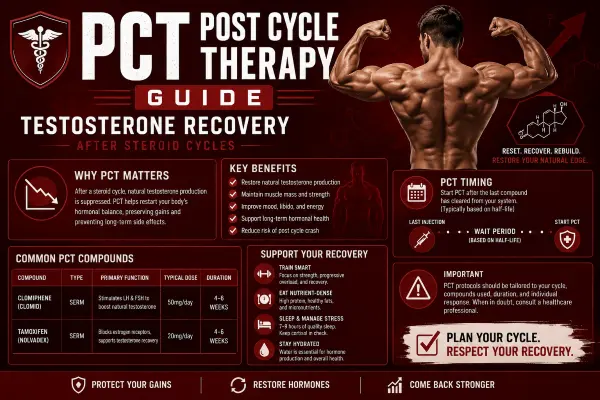
Post Cycle Therapy (PCT) is the recovery phase following an anabolic steroid cycle. Its primary goal is to restore natural testosterone production, regulate estrogen levels, and help preserve muscle mass gained during the cycle.
This article organizes what's understood about thymus biology, what causes thymic decline, and how researched peptides like Thymalin, TB-500, and Thymosin Alpha-1 relate to thymic function, along with the evidence quality behind each.

This is top Dragon Pharma Steroids
Customer Reviews
Please leave your review on products or service below.
Thank you beforehand.