


Semax Peptide: Neurogenesis, BDNF, and Cognitive Research Overview
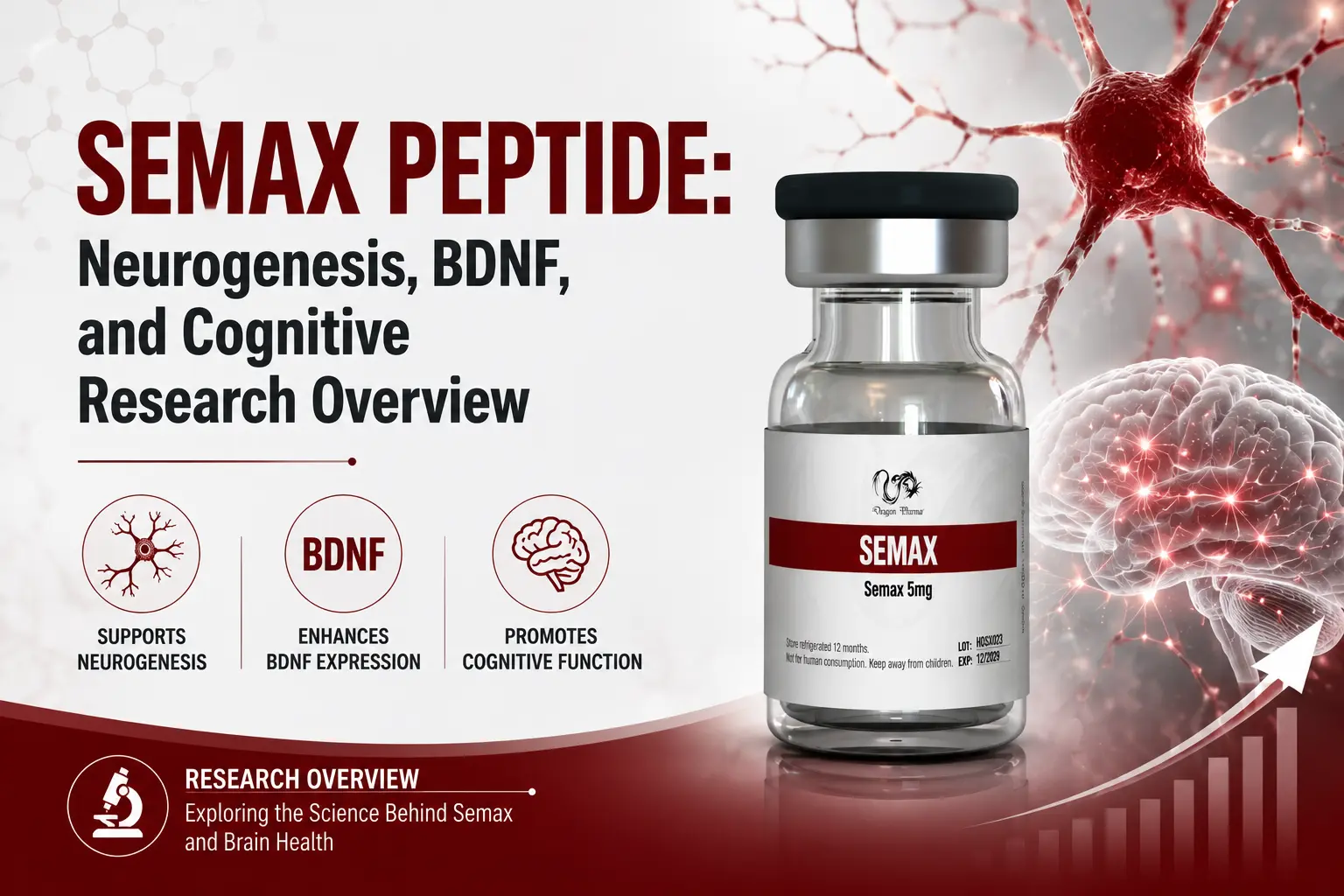
Semax is a synthetic peptide fragment derived from adrenocorticotropic hormone (ACTH), studied almost exclusively in rodent models for its effects on BDNF signaling, neuroprotection during cerebral ischemia, and cognitive performance. This article organizes the available research by mechanism and study type, distinguishing behavioral findings from molecular and vascular research.
Key Facts at a Glance
| Property | Detail |
|---|---|
| Structure | Synthetic heptapeptide, corresponds to amino acids 4–10 of ACTH |
| Parent hormone | Adrenocorticotropic hormone (ACTH) |
| Primary research model | Rodents (rats) |
| Key molecular target | BDNF/trkB signaling pathway |
| Main research areas | Neurogenesis, memory/cognition, cerebral ischemia protection, vascular gene expression |
| Human clinical trial data | Limited; most robust findings come from Russian-language clinical literature and rodent studies — not comprehensively validated in Western clinical trials |
| Route studied | Primarily intranasal administration in research models |
What Is Semax?
Semax is a synthetic analog of a fragment of ACTH, engineered to retain neurological signaling activity without triggering the hormonal (corticosteroid-related) effects associated with full-length ACTH. Because it is derived from a naturally active hormone fragment, it has been studied specifically for central nervous system effects rather than adrenal or endocrine activity.
Semax and BDNF/trkB Signaling
Semax's primary researched mechanism involves upregulating brain-derived neurotrophic factor (BDNF) and its receptor, trkB, both of which are central to neuroplasticity and memory formation.
In rat studies, Semax exposure was associated with:
- Approximately a 1.4-fold increase in BDNF protein levels
- Approximately a 1.6-fold increase in trkB tyrosine phosphorylation
- A 3-fold increase in exon III BDNF mRNA and a 2-fold increase in trkB mRNA in the hippocampus
Definition — BDNF: Brain-derived neurotrophic factor is a protein that supports the survival of existing neurons and encourages the growth of new neurons and synapses, playing a central role in learning and memory.
These molecular changes were paired with behavioral findings: rats exposed to Semax showed an increased number of conditioned avoidance reactions, a standard behavioral measure researchers use to assess learning and memory retention.
Semax and Memory Research in Amnesia Models
In rodent amnesia models, Semax was studied alongside a comparator anti-amnesic compound, with both showing benefits except in cases of amnesia induced by maximal electroshock.
| Comparison Point | Semax | Comparator Anti-Amnesic Compound |
|---|---|---|
| Concentration-response pattern | Bell-shaped, reversible | Linear |
| Effect on CA1 pyramidal neuron activity (hippocampal slices) | Suppressed excessive population response surges | Suppressed excessive population response surges |
| Effect on mitochondrial oxygen consumption | Not the primary effect studied | Improved, with a linear concentration-response relationship |
This bell-shaped response pattern is a notable research detail: it suggests Semax's effects may not simply increase with higher concentrations, but instead peak within a specific dosing range in the animal models studied — an important consideration for how the compound is dosed in research protocols.
Semax in Cerebral Ischemia Research
Semax has been studied for potential neuroprotective effects during cerebral ischemia (restricted blood flow to the brain), primarily through intranasal administration in rat stroke models.
Reported findings in these models include:
- Six days of intranasal Semax exposure was associated with reduced cortical infarction size following induced ischemia
- Improved retention and performance on conditioned passive avoidance tasks (a behavioral memory measure) post-ischemia
- Reduced Vegfa mRNA levels in the frontal cortex and hippocampus following vessel occlusion, suggesting a dampening of hypoxia-induced Vegfa gene expression at early stages of global cerebral ischemia
- Activation of Vegf-b and Vegf-d gene expression, genes distinct from Vegfa, theorized to contribute to a protective vascular response
Definition — VEGF: Vascular endothelial growth factor is a signaling protein family involved in blood vessel formation; different VEGF subtypes can have distinct, sometimes opposing, roles depending on the tissue context and timing of expression.
Semax and Vascular/Cellular Effects
| Researched Effect | Model/Context |
|---|---|
| Vessel formation and stabilization | Observed ~24 hours post-occlusion in rat ischemia models |
| Blood cell activation | Observed ~24 hours post-occlusion |
| Neuroglia and endothelium support | Histological studies in the subventricular zone |
| Progenitor cell support | Subventricular zone, rat models |
| Reduced excess nitric oxide (NO) production | Rat brain cortex |
| Copper (Cu(II)) ion affinity | May reduce copper-induced cytotoxicity in SHSY5Y neuroblastoma and RBE4 endothelial cell lines (in vitro) |
Semax and Circadian Rhythm
Research in rats suggests Semax may influence circadian locomotor rhythm, including changes to rhythm amplitude, a shift in the acrophase (the time of peak activity), and altered spectral characteristics of the activity pattern. Researchers propose this chronotropic (rhythm-synchronizing) activity may be a distinct component of Semax's broader effects as a studied cognitive-enhancement candidate.
Additional Researched Mechanisms
- Enkephalin-degrading enzyme inhibition: Semax has shown concentration-dependent inhibitory effects on serum enkephalin-degrading enzymes, with reported effects more pronounced than certain peptidase inhibitors in comparator studies.
- Mast cell stabilization: Semax is proposed to inhibit histamine release from mast cell activation, suggesting a hypothesis around anti-ulcer activity via mast cell stabilization — though this remains an early-stage research direction.
- Cholinergic system support: In vitro research suggests Semax may improve survival of cholinergic basal forebrain neurons and stimulate choline acetyltransferase activity, without affecting GABAergic neuron counts.
- Dopamine and attention research: Semax is studied for its potential to enhance psychostimulant effects on central dopamine release and its possible role in selective attention and brain development — cited as a rationale for early-stage interest in ADHD and Rett syndrome research contexts.
- Immune-neural interaction: Preclinical findings suggest Semax may influence microglia and leukocyte activation, pointing to a potential neuroimmune signaling role.
- Ophthalmic research: In models of glaucomatous optic neuropathy, Semax has been included in multi-component neuroprotective research approaches studying normalized ophthalmic tone, attributed to its broader neuroprotective and neurotrophic profile.
Semax vs. BDNF-Adjacent Research Compounds
| Feature | Semax | Direct BDNF Administration (research context) |
|---|---|---|
| Mechanism | Upregulates endogenous BDNF/trkB signaling | Delivers BDNF protein directly |
| Blood-brain barrier considerations | Small peptide, studied via intranasal delivery | BDNF protein has limited BBB penetration, a known research challenge |
| Structural origin | ACTH fragment analog | Native neurotrophin |
| Research maturity | Established rodent literature, limited Western human trials | Primarily preclinical due to delivery challenges |
Storage and Stability (Research Use Only)
| Condition | Recommendation |
|---|---|
| Lyophilized form | Store frozen (-20°C) for long-term stability |
| Reconstituted solution | Refrigerate (2–8°C); use within the research protocol's defined window |
| Light exposure | Store protected from light |
| Handling | Avoid repeated freeze-thaw cycles to preserve peptide integrity |
Frequently Asked Questions
What is Semax made from?
Semax is a synthetic peptide corresponding to amino acids 4–10 of adrenocorticotropic hormone (ACTH), modified to retain central nervous system signaling activity.
Does Semax increase BDNF?
Rat studies report approximately a 1.4-fold increase in BDNF protein and a 3-fold increase in exon III BDNF mRNA in the hippocampus following Semax exposure.
Has Semax been tested in humans?
Most robust data comes from Russian-language clinical literature and rodent studies; Semax has not been comprehensively validated through Western human clinical trials.
How is Semax typically administered in research studies?
Intranasal administration is the most commonly studied route in the available rodent research literature.
Does Semax help with memory in animal studies?
Yes — rat studies report increased conditioned avoidance reactions and improved passive avoidance performance, both standard behavioral memory measures, following Semax exposure.
What is the connection between Semax and stroke research?
In rat models of cerebral ischemia, intranasal Semax exposure over six days was associated with reduced cortical infarction size and altered VEGF-family gene expression.
Does Semax affect dopamine?
Preclinical research suggests Semax may enhance the effects of psychostimulants on central dopamine release, an area of interest in attention-related research contexts.
Is Semax the same as ACTH?
No. Semax is a fragment-derived analog of ACTH engineered to preserve central nervous system activity while avoiding the adrenal hormone effects of full-length ACTH.
What is the bell-shaped concentration effect noted in Semax research?
Some rat studies found Semax's effects didn't scale linearly with dose — instead, effects peaked at a specific concentration range and diminished outside of it, unlike the linear pattern seen in a comparator anti-amnesic compound.
Does Semax have antioxidant or metal-binding properties?
Research suggests Semax has a high affinity for copper ions and may reduce copper-induced cytotoxicity in specific neuroblastoma and endothelial cell lines studied in vitro.
What conditions is Semax being researched for beyond memory?
Early-stage research interest includes ADHD, Rett syndrome, glaucomatous optic neuropathy, and mast cell–related anti-ulcer activity, though these remain exploratory research directions.
Key Takeaways
- Semax is an ACTH-derived synthetic peptide studied primarily in rodent models for effects on BDNF/trkB signaling, memory, and neuroprotection.
- Molecular research shows measurable increases in BDNF protein, trkB phosphorylation, and related mRNA expression in the rat hippocampus.
- Semax has shown neuroprotective associations in rat cerebral ischemia models, including reduced infarction size and altered VEGF-family gene expression.
- Effects on memory and cognition follow a bell-shaped, concentration-dependent pattern rather than a linear dose-response relationship in available rodent data.
- Most available evidence is preclinical and rodent-based; comprehensive Western human clinical trial data is limited.
- When selecting a Dragon Pharma peptides supplier, researchers should choose reputable sources that provide research-grade Semax intended exclusively for laboratory and scientific research.
Articles
It has been researched across cancer, chronic infection, and immunodeficiency models. This article organizes its proposed mechanisms, immune targets, and evidence base by research category.
This article covers its receptor mechanism, evidence across bone, nitrogen, and energy-balance research, and corrects a significant framing issue in secondary literature: a human pharmacokinetic trial in this compound's own history is commonly described as testing "mammalian models" rather than the human volunteers it actually involved.

The number 400 generally refers to a total concentration of approximately 400 mg of testosterone esters per milliliter. However, this doesn't necessarily mean that every milliliter contains 400 mg of active, unmodified testosterone because the ester molecules contribute to the total weight.
Customer Reviews
Please leave your review on products or service below.
Thank you beforehand.