Manufacturer
Brand Dragon Pharma
Product Format Lyophilized Research Peptide
Core Information
Substance Cartalax (AED Peptide)
Classification Synthetic Peptide Bioregulator
Peptide Sequence Ala-Glu-Asp
Molecular Weight 333.29 g/mol
Molecular Formula C₁₂H₁₉N₃O₈
Research Properties
Cartilage Research Chondrocyte activity & cartilage biology
Connective Tissue Extracellular matrix & collagen pathways
Cellular Aging Senescence & gene expression studies
Regenerative Research Cell signaling & tissue maintenance
Main Research Areas
Cartilage Support Research Investigation of chondrocyte function, cartilage homeostasis, and extracellular matrix regulation
Connective Tissue Research Fibroblast activity, collagen metabolism, and connective tissue biology studies
Popular Research Use Peptide bioregulator research, tissue biology, and cellular physiology studies
Main Research Goal Understanding peptide signaling pathways involved in tissue maintenance and regeneration
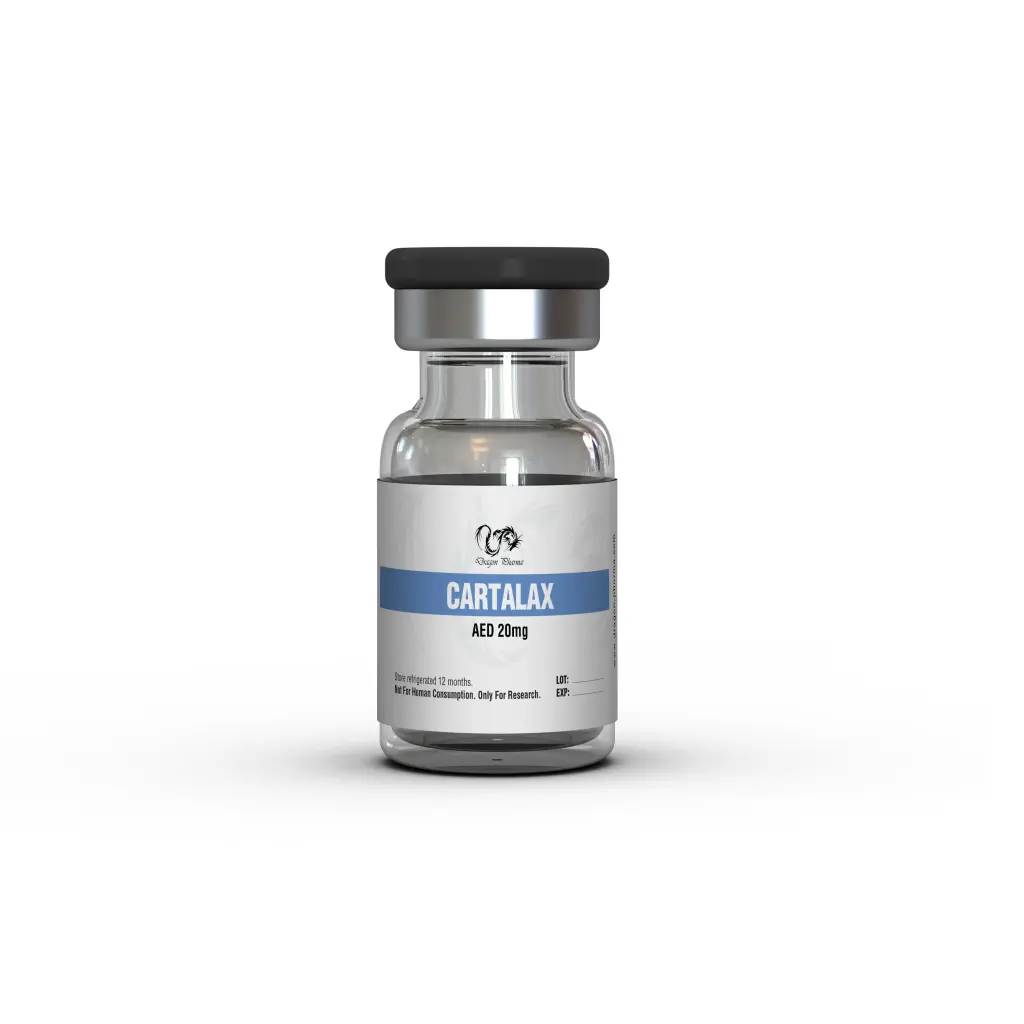
Dragon Pharma Cartalax 20mg Peptide
Dragon Pharma Cartalax 20mg is a pharmaceutical-grade synthetic tripeptide composed of three amino acids — Alanine, Glutamic Acid, and Aspartic Acid (AED) — whose sequence mirrors a segment of the alpha-1 chain of Type XI collagen, a structural protein found in cartilage and connective tissue throughout the body. As one of the most structurally specific anti-aging research peptides available, Cartalax is studied for its potential role in collagen signaling, cellular senescence modulation, mitochondrial resilience, and extracellular matrix preservation — four interconnected biological systems that collectively determine the rate and quality of tissue aging.
Unlike broader collagen interventions that stimulate general collagen synthesis, Dragon Pharma Cartalax 20mg peptide is researched for its structural mimicry of Type XI collagen — the specific collagen subtype responsible for cartilage mechanical stress absorption and joint integrity maintenance. This structural specificity is what distinguishes Cartalax from standard collagen support compounds and positions it as a precision anti-aging research tool rather than a general tissue support peptide.
The Biology Behind Dragon Pharma Cartalax
Tissue aging is not a single-system failure — it is the simultaneous deterioration of collagen architecture, cellular repair capacity, mitochondrial energy production, and inflammatory regulation. Dragon Pharma Cartalax 20mg peptide is studied across all four of these axes, making it one of the few research tripeptides with a multi-system biological profile.
1. Type XI Collagen Mimicry and Extracellular Matrix Preservation
Cartalax's AED sequence structurally resembles the alpha-1 chain of Type XI collagen — a collagen subtype that works alongside Type II collagen to maintain cartilage architecture and absorb mechanical stress in joints including the knee, hip, and spine. As collagen production declines with age — from approximately 200 ng/mL of circulating collagen peptides at age 20 to roughly half that by age 60 — cartilage loses its structural integrity, contributing to joint stiffness, degeneration, and osteoarthritis.
Researchers hypothesize that Cartalax may interact with collagen signaling pathways by mimicking naturally occurring collagen-derived peptides, potentially influencing extracellular matrix preservation and tissue healing responses under mechanical stress — though this remains under active investigation in preclinical models.
2. Cellular Senescence Modulation — p16, p21, p53, and SIRT6
At the cellular level, aging manifests through cell senescence — a state where cells stop dividing and begin producing chronic low-grade inflammation that accelerates surrounding tissue degradation. Key protein markers of cellular senescence include p16, p21, and p53 — their elevated expression indicates cells entering or already in a senescent state.
Early cell culture research suggests Cartalax may reduce expression of these senescence markers while simultaneously elevating SIRT6 — a longevity-associated protein directly involved in DNA repair, genome stability, and the suppression of age-related inflammatory gene expression. If confirmed in more advanced models, this dual action — reducing senescence signals while supporting DNA repair capacity — would position Cartalax as a genuinely mechanistic anti-aging research compound rather than a symptomatic support peptide.
3. Mitochondrial Function and Oxidative Stress Resilience
Mitochondria — the cell's energy-producing organelles — progressively lose efficiency with age under the accumulation of oxidative stress. This mitochondrial deterioration produces the characteristic symptoms of cellular aging: fatigue, reduced tissue repair capacity, muscle weakness, and increased susceptibility to age-related disease.
Research in mitochondrial-targeted peptides — reviewed in GeroScience 2023 — suggests that peptides modulating stress-related cellular pathways may promote mitochondrial resilience and reduce inflammatory burden in aging tissue. Cartalax is studied within this context for potential stabilization of mitochondrial function through stress pathway regulation — supporting cellular energy production and redox capacity in tissue undergoing age-related decline.
4. Chronic Inflammation Modulation
Chronic low-grade inflammation sits at the intersection of virtually every major age-related pathology — arthritis, cardiovascular disease, cognitive decline, and accelerated cartilage loss. Cartalax is studied for its potential to influence how cells respond to inflammatory stress — not through broad immune suppression but through modulation of the cellular stress response pathways that determine whether inflammatory signals amplify or resolve over time.
Dragon Pharma Cartalax 20mg — Key Research Benefits
- Cartilage and connective tissue research — Type XI collagen sequence mimicry positions Cartalax as a structurally specific research tool for cartilage integrity, joint degeneration, and extracellular matrix preservation studies
- Cellular senescence reduction — p16, p21, p53 expression modulation alongside SIRT6 elevation addresses the cellular aging markers most directly linked to tissue breakdown and chronic inflammatory burden
- Mitochondrial resilience support — oxidative stress pathway regulation maintains cellular energy production and redox capacity in aging tissue research models
- Anti-aging and longevity research — SIRT6 elevation connects Cartalax to the most studied molecular longevity pathways — DNA repair, genome stability, and age-related gene expression modulation
- Tissue integrity preservation — extracellular matrix framework support across high-impact anatomical areas (knee, hip, spine) where collagen loss produces the most functionally significant aging-related decline
- Non-hormonal mechanism — no androgen receptor interaction, no HPG axis involvement, no aromatization — Cartalax operates entirely through collagen signaling and cellular stress pathways, compatible with any research protocol
Dragon Pharma Cartalax 20mg Dosage and Protocol Guide
Dragon Pharma Cartalax 20mg is supplied as a sterile lyophilized powder requiring reconstitution with bacteriostatic water before subcutaneous administration. As an investigational research peptide, dosing is extrapolated from preclinical studies and emerging practitioner protocols rather than established clinical guidelines.
| Protocol |
Daily Dose |
Frequency |
| Conservative / Starting |
100–200 mcg/day |
Daily SubQ |
| Standard Research |
200–500 mcg/day |
Daily SubQ |
| Advanced Protocol |
500 mcg–1mg/day |
Daily or split AM/PM |
Cycle structure:
- Active phase: 8–12 weeks of consistent daily subcutaneous administration
- Off period: 4–8 weeks off or step down to 2–3x weekly maintenance dosing
- Long-term protocols: anti-aging and longevity research typically runs extended cycles with periodic breaks rather than continuous indefinite administration
Administration notes:
- Reconstitute with bacteriostatic water under aseptic conditions; gently swirl — do not shake
- Administer via subcutaneous injection into abdominal or thigh tissue
- Refrigerate after reconstitution; use within 28 days
- Start at conservative dose to establish individual response before progressing to standard research range
Results Timeline — Dragon Pharma Cartalax 20mg Peptide
- Weeks 1–4: early cellular stress pathway modulation; initial oxidative stress reduction in research models; baseline inflammatory marker changes
- Weeks 4–8: measurable senescence marker changes (p16, p21, p53 expression); SIRT6 elevation becoming quantifiable; early extracellular matrix integrity improvements in cartilage-focused research models
- Weeks 8–12: peak collagen signaling and extracellular matrix preservation outcomes; sustained mitochondrial resilience markers; DNA repair pathway activity measurable across research endpoints
Research Stacking Protocols
Dragon Pharma Cartalax 20mg peptide operates through collagen signaling and cellular senescence pathways — mechanisms entirely distinct from angiogenic, anti-inflammatory, and GH-axis peptides. This creates genuine non-redundant stacking opportunities with complementary research compounds.
Comprehensive Anti-Aging and Tissue Repair Stack:
- Dragon Pharma Cartalax 20mg: 200–500 mcg/day — Type XI collagen mimicry, SIRT6 elevation, senescence marker reduction
- GHK-Cu: standard research dose — COL1A1/COL3A1 collagen gene activation, lysyl oxidase cross-linking, extracellular matrix rebuilding; complements Cartalax's collagen signaling focus with direct collagen synthesis gene activation
- BPC-157: standard research dose — VEGF-driven angiogenesis ensuring vascular supply to cartilage and connective tissue repair sites; addresses the blood supply bottleneck that limits collagen repair signal delivery
Longevity and Cellular Aging Stack:
- Dragon Pharma Cartalax 20mg: 200–500 mcg/day — SIRT6/DNA repair axis
- Epitalon: 5–10 mg daily — telomere biology and pineal function modulation; operates on the aging-clock at the chromosomal level while Cartalax addresses the cellular senescence and tissue integrity axis — genuinely complementary longevity mechanisms
Joint and Cartilage Recovery Stack:
- Dragon Pharma Cartalax 20mg: 200–500 mcg/day — Type XI collagen mimicry and extracellular matrix preservation
- TB-500: standard research dose — G-actin sequestration, repair cell migration to cartilage and connective tissue sites; TGF-β modulation biasing healing toward functional tissue over fibrotic scarring
- BPC-157: standard research dose — angiogenesis supplying vascular infrastructure to joint repair sites
Cartalax vs Other Anti-Aging Research Peptides
| Compound |
Primary Mechanism |
vs Cartalax |
| Cartalax |
Type XI collagen mimicry, SIRT6, p16/p21/p53 senescence modulation |
Cellular aging and collagen signaling axis |
| Epitalon |
Telomere elongation, pineal/melatonin regulation |
Chromosomal aging clock — complementary, non-redundant |
| GHK-Cu |
COL1A1/COL3A1 gene activation, 4,000+ gene modulation |
Collagen synthesis — downstream of Cartalax's signaling |
| BPC-157 |
Angiogenesis, VEGF, tissue barrier stability |
Vascular supply — enables collagen repair signal delivery |
| TB-500 |
Cell migration, TGF-β, anti-fibrotic |
Repair cell organization — structural repair layer |
| KPV |
NF-κB inhibition, cytokine suppression |
Inflammation control — clears environment for Cartalax repair signals |
Side Effects and Safety Profile
Dragon Pharma Cartalax 20mg peptide carries one of the most favorable safety profiles in the research tripeptide category — a direct consequence of its small three-amino-acid structure and non-hormonal, non-androgenic mechanism.
- No androgenic activity — zero androgen receptor interaction, no testosterone suppression, no HPG axis involvement
- No aromatization — no estrogen conversion, no estrogenic side effects
- No hepatotoxicity — no liver stress at any standard research dose
- No water retention — mechanism operates through cellular signaling pathways, not hormonal or mineralocorticoid systems
- Injection site reactions — mild redness or irritation at subcutaneous injection site; most commonly reported effect; minimized by site rotation and aseptic technique
- Mild fatigue or lethargy — possible during initial adaptation period; self-resolving within the first 1–2 weeks
As an investigational compound with primarily preclinical data, long-term safety in human subjects has not been fully established. All research use should follow appropriate oversight protocols.
Why Dragon Pharma Cartalax 20mg?
For a research tripeptide with a precise three-amino-acid sequence, synthesis accuracy and verified peptide identity are the primary quality variables — a single amino acid substitution or sequence error produces a fundamentally different compound with unpredictable biological activity. Dragon Pharma Cartalax 20mg provides:
- Confirmed AED tripeptide sequence (Alanine-Glutamic Acid-Aspartic Acid) verified through independent third-party mass spectrometry and HPLC purity analysis
- Confirmed 20mg peptide concentration per vial — pharmaceutical-grade lyophilized powder preserving full tripeptide bioactivity through reconstitution
- Batch-level COA documentation — not generic or reused across production runs; sequence identity and purity confirmed per batch
- Trusted by researchers worldwide as the highest-concentration Cartalax peptide option in the Dragon Pharma anti-aging research peptide line
Dragon Pharma Cartalax is a synthetic tripeptide bioregulator researched for its role in cartilage biology, connective tissue pathways, extracellular matrix regulation, and cellular physiology. Its defined Ala-Glu-Asp sequence and lyophilized format make it a valuable research compound for studies exploring peptide signaling, tissue maintenance, and regenerative biology.