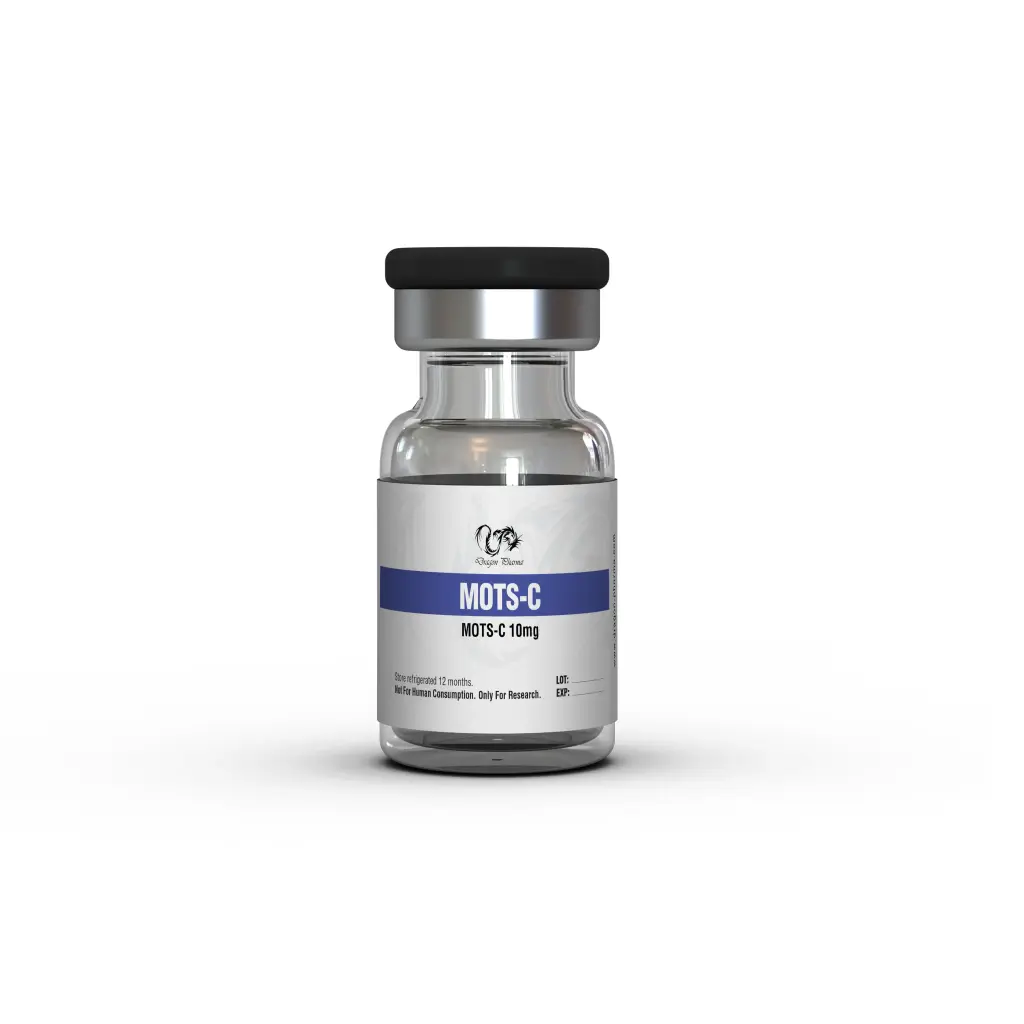
Manufacturer
Brand Dragon Pharma
Last Lab Tested None
Core Information
Substance MOTS-c (Mitochondrial Open Reading Frame of the 12S rRNA-c)
Classification Mitochondrial-derived peptide / metabolic regulator
Active Half-Life 30 minutes
Typical Dosage (Men) 5–15 mg/week
Effects & Properties
Water Retention No
Aromatization No
Hepatotoxicity No
Hair Loss Risk (HBR) No
Acne No
The Peptide the Mitochondria Wrote
Every other research peptide in the Dragon Pharma catalog is encoded by nuclear DNA. MOTS-c is not. It is written into the mitochondrial genome — specifically within the 12S rRNA gene — making it a member of a newly identified and still-expanding class of biological signals called mitochondria-derived peptides (MDPs). Its discovery in 2015 fundamentally changed how researchers understand the relationship between mitochondrial function and systemic metabolism.
What makes MOTS-c genuinely different from conventional metabolic research peptides is not just its genomic origin — it is what the peptide does with that origin. Under conditions of metabolic stress, MOTS-c translocates from the mitochondrion to the cell nucleus, where it directly regulates nuclear gene expression. This bidirectional organelle-to-nucleus communication is a research axis that did not exist in the literature before 2015 and that no nuclear-encoded peptide can replicate.
Dragon Pharma MOTS-c delivers 16 amino acids (Met-Arg-Trp-Gln-Glu-Met-Gly-Tyr-Ile-Phe-Tyr-Pro-Arg-Lys-Leu-Arg) in research-grade lyophilized form, verified at ≥99% purity by HPLC with LC-MS sequence confirmation. Every vial ships with an independent third-party Certificate of Analysis.
Quick Reference
| Parameter |
Detail |
| Brand |
Dragon Pharma |
| Compound |
MOTS-c (Mitochondrial Open Reading Frame of the 12S rRNA-c) |
| Sequence |
Met-Arg-Trp-Gln-Glu-Met-Gly-Tyr-Ile-Phe-Tyr-Pro-Arg-Lys-Leu-Arg |
| Residues |
16 amino acids |
| Genome Origin |
Mitochondrial DNA — 12S rRNA gene |
| Peptide Class |
Mitochondria-Derived Peptide (MDP) |
| Primary Mechanism |
Folate cycle inhibition → AICAR accumulation → AMPK activation |
| Secondary Mechanism |
Nuclear translocation under metabolic stress; NRF2 interaction |
| Primary Research Target |
Skeletal muscle; metabolic regulation; aging biology |
| Molecular Formula |
C101H152N28O22S2 |
| Molecular Weight |
2174.6 g/mol |
| CAS Number |
1627580-64-6 |
| PubChem CID |
255386757 |
| Discovered |
2015 — Lee et al., Cell Metabolism |
| Form |
Lyophilized powder |
| Purity |
≥99% (HPLC verified) |
| Identity |
LC-MS confirmed (sequence + 2174.6 g/mol mass) |
| COA |
Independent third-party, per batch |
| Storage (dry) |
-20°C, protect from light; 24+ months |
| Storage (reconstituted) |
2–8°C, 28 days |
| WADA Status |
Prohibited List 2024 (AMPK activator — S2 class) |
| Research Use |
In vitro research only |
How MOTS-c Works: The AMPK Master Switch
MOTS-c's mechanism is two-part and operates across cellular compartments — a level of biological complexity rare for a research peptide of any size, let alone a 16-residue sequence.
Part 1 — Folate Cycle Inhibition and AMPK Activation
MOTS-c inhibits the folate cycle, a one-carbon metabolic pathway involved in de novo purine synthesis. This inhibition causes accumulation of AICAR (5-aminoimidazole-4-carboxamide-1-β-D-ribofuranoside) — an endogenous AMPK activator. The result is AMPK activation that occurs independently of the cellular AMP:ATP ratio, making MOTS-c's route of AMPK engagement mechanistically distinct from direct energy depletion.
AMPK activation by this pathway triggers a coordinated cellular response:
- GLUT4 translocation to muscle cell membranes — increased glucose uptake independent of insulin signaling
- Lipid β-oxidation enhancement — increased fatty acid utilization for cellular energy production
- Mitochondrial biogenesis via PGC-1α — new mitochondria formation expanding overall energy production capacity
- mTOR suppression — energy-conserving inhibition of anabolic biosynthetic programs during metabolic stress
Part 2 — Nuclear Translocation and Gene Regulation
Under metabolic stress, MOTS-c physically translocates from the mitochondrial compartment to the cell nucleus — a process that is AMPK-dependent. Once in the nucleus, it interacts with stress-responsive transcription factors including NRF2, modulating gene expression programs governing antioxidant responses and glucose metabolism. This mitochondria-to-nucleus communication axis establishes MOTS-c as more than a signaling peptide — it functions as an active gene regulatory agent that connects the mitochondrion's assessment of metabolic state to the nucleus's gene expression output.
Four Primary Research Domains
1. Metabolic Regulation and Insulin Sensitivity
The foundational MOTS-c research application. The 2015 Cell Metabolism paper by Lee et al. that introduced MOTS-c to the scientific community documented prevention of diet-induced obesity and insulin resistance in animal models through AMPK-mediated enhancement of skeletal muscle glucose metabolism. Subsequent work has examined GLUT4 upregulation in high-fat diet models, hepatic steatosis reduction, and fat oxidation support through the AMPK-PGC-1α axis.
In postmenopausal metabolic dysfunction models, MOTS-c has been studied for fat mass reduction, brown adipose tissue activity maintenance, inflammatory response suppression, and prevention of hormonal transition-related insulin resistance — establishing a research platform directly relevant to age-associated metabolic decline.
2. Skeletal Muscle Homeostasis and Physical Performance
A 2021 Nature Communications study established MOTS-c as an exercise-induced mitochondrial-encoded regulator of age-dependent physical decline. Key documented findings:
- Physical exercise induces MOTS-c expression in both skeletal muscle tissue and circulation in human subjects — establishing physiological relevance beyond animal models
- MOTS-c administration enhanced physical performance across young, middle-aged, and old animal cohorts — the cross-age-group effect being particularly notable for aging biology research
- MOTS-c reduces myostatin levels through the PTEN/AKT/FOXO1 pathway — creating an anti-catabolic muscle environment without direct androgenic mechanisms
- MOTS-c aids myoblast adaptation to metabolic stress, supporting muscle function maintenance under conditions that typically lead to atrophy
3. Neuroprotection and Cognitive Research
Research has examined MOTS-c in neuroinflammation and cognitive function models. A 2021 ACS Chemical Neuroscience study demonstrated that peripheral administration of a cell-penetrating MOTS-c analogue enhanced memory and reduced Aβ1-42-induced and LPS-induced memory impairment through inhibition of neuroinflammatory pathways — including suppression of astrocyte and microglial activation and reduction in TNF-α, IL-6, IL-1β, COX-2, and iNOS production.
In traumatic brain injury models, MOTS-c was investigated for its capacity to enhance lipid β-oxidation to provide metabolic energy to the injured brain, reduce molecular damage, and improve cell survival — representing a metabolic support mechanism for neuroprotection distinct from direct anti-inflammatory pathways.
4. Longevity and Anti-Aging Research
Two converging lines of evidence support MOTS-c's relevance to aging biology research. First, circulating MOTS-c plasma levels decline with age in humans — a pattern consistent with other endogenous longevity-associated signals and relevant to biomarker research in metabolic aging. Second, a specific polymorphism in the mitochondrial 12S rRNA gene's MOTS-c-encoding region has been associated with exceptional human longevity in genetic studies — providing population-level genetic evidence for the peptide's role in lifespan biology that goes beyond its pharmacological effects in model systems.
MOTS-c in the Metabolic Research Peptide Landscape
| Compound |
Primary Mechanism |
Relationship to MOTS-c |
| MOTS-c |
Folate cycle → AICAR → AMPK; nuclear translocation; metabolic gene regulation |
Base compound — mitochondrial metabolic axis |
| Epitalon |
Telomere elongation, pineal/melatonin regulation |
Chromosomal aging clock — complementary, non-redundant |
| Cartalax (AED) |
SIRT6 elevation, p16/p21/p53 senescence modulation |
Cellular senescence axis — complementary to MOTS-c's metabolic focus |
| BPC-157 |
VEGF angiogenesis, tissue repair signaling |
Structural repair layer — vascular support for muscle recovery research |
| GHK-Cu |
COL1A1/COL3A1 gene activation, 4,000+ gene modulation |
Collagen and gene expression breadth — different pathway, shared aging research context |
Key Features
- ✔ Mitochondrial genome origin — an entirely different peptide class — encoded by mitochondrial not nuclear DNA; as an MDP it occupies a research space no conventional peptide can access
- ✔ Mitochondria-to-nucleus signaling capability — the only characterized research peptide that directly translocates between organelles under metabolic stress to regulate nuclear gene expression
- ✔ AMPK activation via folate cycle — mechanistically distinct route — AICAR-mediated AMPK activation independent of AMP:ATP ratio; not replicable by direct AMPK activators
- ✔ Exercise-induced expression documented in humans — Reynolds et al. (2021, Nature Communications) confirmed MOTS-c induction in human skeletal muscle and circulation by physical exercise
- ✔ Longevity-associated genetic polymorphism — mitochondrial genome variant linked to exceptional human longevity; rare pharmacological-genetic bridge
- ✔ Declining plasma levels with age documented in humans — supports its role as a metabolic aging biomarker and research tool for age-related decline
- ✔ ≥99% HPLC purity with LC-MS sequence confirmation — complete identity verification for a 16-residue peptide where synthesis complexity elevates sequence error risk
- ✔ Nine peer-reviewed publications — Cell Metabolism, Nature Communications, ACS Chemical Neuroscience, IJMS, Aging Cell, and others
- ✔ Independent third-party COA per batch — lot-traceable documentation; not reused across production runs
Research Context — WADA 2024 Classification: WADA added MOTS-c to its Prohibited List in 2024 as an AMPK activator, citing exercise-mimetic metabolic effects. Researchers designing protocols involving MOTS-c in exercise physiology or sports science contexts should address this classification in institutional review documentation. Dragon Pharma MOTS-c is supplied for in vitro research use only.
Research Benefits
Access to a research mechanism that no nuclear-encoded peptide provides. MOTS-c's mitochondrial genome origin and nuclear translocation capability give researchers a tool for studying the mitochondria-nucleus communication axis in metabolic stress biology — an area of investigation that has no equivalent in the conventional research peptide catalog. For laboratories building models of mitochondrial signaling, cellular energy sensing, or organelle crosstalk, MOTS-c is currently the primary characterized tool compound available.
Human exercise physiology validation. Many metabolic research peptides are characterized exclusively in animal models. MOTS-c has the additional credibility of documented exercise-induced expression in human skeletal muscle and circulation (Reynolds et al., Nature Communications, 2021) — a human relevance anchor that meaningfully contextualizes animal model findings and strengthens the scientific rationale for laboratory investigation.
Multi-system research utility from a single compound. Metabolic regulation, skeletal muscle homeostasis, neuroinflammation, and longevity genetics represent four distinct research domains supported by nine peer-reviewed publications. A researcher building a comprehensive metabolic aging model can use MOTS-c to address the mitochondrial signaling axis while pairing it with Epitalon (telomere/pineal axis), Cartalax (cellular senescence axis), and GHK-Cu (gene expression breadth) for a genuinely multi-mechanism approach.
Genetic evidence beyond pharmacology. The longevity polymorphism identified in the MOTS-c encoding region provides a dimension of scientific support that purely synthetic research compounds cannot offer — evidence that variation in endogenous MOTS-c production is linked to differential lifespan outcomes in human populations, anchoring pharmacological research in evolutionary and genetic context.
Dragon Pharma Quality Assurance for MOTS-c
At 2174.6 g/mol and 16 residues including two methionine sulfur-containing amino acids and multiple aromatic residues (Trp, Tyr × 2, Phe × 2), MOTS-c is among the more structurally complex peptides in the Dragon Pharma research catalog. Synthesis complexity scales with chain length and amino acid composition — making LC-MS sequence verification particularly critical for a 16-residue compound where a single substitution produces a different and potentially inactive research tool.
- HPLC purity — ≥99% confirmed by reverse-phase chromatography
- LC-MS identity — confirms the complete 16-residue Met-Arg-Trp-Gln-Glu-Met-Gly-Tyr-Ile-Phe-Tyr-Pro-Arg-Lys-Leu-Arg sequence and 2174.6 g/mol molecular mass
- Sterility and endotoxin testing — per batch specification
- Residual solvent screening — confirms clean synthesis
- Batch-specific independent COA — issued per production run; lot number on vial label traceable to laboratory documentation
Product Summary
Dragon Pharma MOTS-c is a synthetic 16-amino acid mitochondria-derived peptide (CAS 1627580-64-6) encoded by the mitochondrial genome's 12S rRNA gene. It activates AMPK through folate cycle inhibition and AICAR accumulation, translocates to the nucleus under metabolic stress to regulate gene expression via NRF2, and has been documented in peer-reviewed research across metabolic regulation, skeletal muscle homeostasis, neuroprotection, and longevity biology. Exercise-induced expression in human subjects is documented. A longevity-associated genetic polymorphism in its encoding region links MOTS-c to exceptional human lifespan at the population-genetics level. Supplied at ≥99% HPLC purity, LC-MS sequence confirmed, with independent third-party COA per batch. For research use only.
Best for: Metabolic regulation research • AMPK pathway biology • Skeletal muscle and exercise physiology research • Neuroinflammation models • Longevity and aging biology • Mitochondrial signaling research