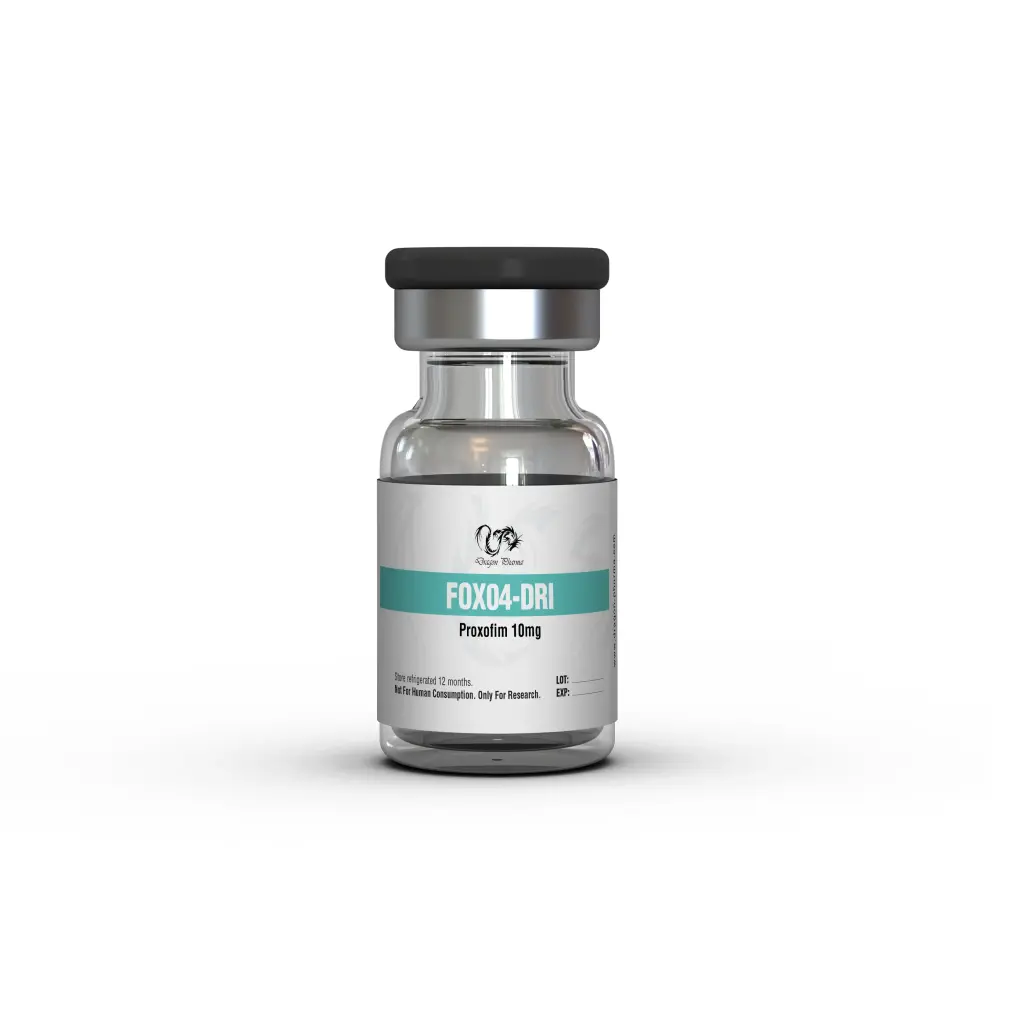
Dragon Pharma FOXO4-DRI (Proxofim) — Senolytic Peptide Research Compound
Every cell in the body is programmed to die when it becomes too damaged to function properly. In healthy tissue, this quality-control process — apoptosis — runs continuously, clearing dysfunctional cells and making room for functional replacements. Senescent cells have broken this system. They accumulate DNA damage, stop dividing, and then refuse to die — earning the label "zombie cells" in the popular science literature for good reason. They remain metabolically active, secreting a chronic inflammatory signal known as SASP that progressively degrades surrounding healthy tissue, recruits immune cells, and induces neighboring cells into senescence themselves.
FOXO4-DRI (Proxofim) was designed to restore the broken apoptosis signal in these cells. Developed at Erasmus University Medical Center and first published in Cell in 2017, it targets a specific molecular mechanism that senescent cells use to suppress p53 — their primary death signal — by keeping it bound to an elevated FOXO4 protein. By disrupting this FOXO4-p53 interaction, Dragon Pharma FOXO4-DRI releases p53 to do its intended job: initiating programmed cell death in cells that should have died already.
Dragon Pharma FOXO4-DRI is supplied as a lyophilized research-grade peptide at ≥99% HPLC purity, with LC-MS sequence and D-amino acid configuration confirmed. Every vial ships with an independent third-party Certificate of Analysis. For research use only.
Product Specifications
| Parameter |
Detail |
| Brand |
Dragon Pharma |
| Compound |
FOXO4-DRI (Proxofim / FOXO4-D-Retro-Inverso) |
| Other Names |
AFX, AFX1, MLLT7, FOXO4a, EX-A7431, Forkhead box protein O4 |
| Sequence |
LTLRKEPASEIAQSILEAYSQNGWANRRSGGKRPPPRRRQRRKKRG
(46 residues, all D-amino acids) |
| Chirality |
D-retro-inverso — reversed sequence, D-amino acid configuration |
| Molecular Formula |
C228H388N86O64 |
| Molecular Weight |
5358.05 g/mol |
| CAS Number |
2460055-10-9 |
| Mechanism |
FOXO4-p53 PPI disruption → p53 nuclear exclusion → mitochondrial apoptosis in senescent cells |
| Research Class |
Senolytic peptide — cellular senescence biology |
| Cell Permeability |
Cell-penetrating; nuclear access documented |
| Form |
Lyophilized powder |
| Purity |
≥99% (HPLC verified) |
| Identity |
LC-MS (sequence, mass, D-chirality confirmed) |
| COA |
Independent third-party, per batch |
| Storage (dry) |
-20°C, protect from light; 24+ months |
| Storage (reconstituted) |
2–8°C, 28 days |
| Original Study |
Baar et al., Cell, 2017 — Erasmus University Medical Center |
| Research Use |
In vitro research only |
The Science in Three Layers
Layer 1 — Why Senescent Cells Are a Research Target
Cellular senescence was first described as a simple stress response — cells stop dividing to prevent damaged DNA from being replicated and passed to daughter cells. The problem is what comes next. Rather than dying cleanly, senescent cells remain metabolically active and adopt the SASP (senescence-associated secretory phenotype): a chronic, high-volume secretion of inflammatory molecules that includes IL-1α, IL-1β, IL-6, IL-8, TNF-α, CXCL1, CCL2, MMP-1, MMP-3, MMP-10, VEGF, and HGF. This output progressively degrades surrounding extracellular matrix, amplifies inflammation, induces senescence in neighboring healthy cells, and creates a tissue environment that impairs regenerative capacity. The accumulation of senescent cells with age — and the SASP burden they create — is now recognized as a significant driver of tissue dysfunction across multiple organ systems.
Layer 2 — Why Senescent Cells Resist Apoptosis
The key molecular event: in senescent cells, FOXO4 expression is elevated. FOXO4 binds p53 in the nucleus, sequestering it from its pro-apoptotic targets. Normally, when p53 is activated by DNA damage or cellular stress, it initiates transcription of pro-apoptotic genes and triggers the intrinsic apoptotic cascade. Bound to FOXO4, it cannot. The senescent cell has essentially disabled its own death switch by exploiting a physiological FOXO4 function and turning it into a survival mechanism. This is a dependency unique to senescent cells — healthy proliferating cells do not require sustained FOXO4-p53 binding to survive.
Layer 3 — How FOXO4-DRI Works
FOXO4-DRI competitively binds FOXO4 at the p53-interaction domain, preventing FOXO4 from sequestering p53. Released from nuclear retention, p53 translocates to the mitochondria — a well-characterized step in the intrinsic apoptotic pathway. At the mitochondria, p53 engages BCL-2 family pro-apoptotic proteins, triggering mitochondrial outer membrane permeabilization, cytochrome c release, caspase activation, and programmed cell death. The senescent cell is eliminated. Because healthy proliferating cells do not depend on the FOXO4-p53 survival mechanism, FOXO4-DRI does not trigger equivalent apoptosis in non-senescent populations — this selectivity is the central research rationale for its value as a senolytic tool.
Critically, research suggests FOXO4-DRI's targeted disruption spares FOXO4's antioxidant transcriptional function — FOXO4 retains its role as activator of MnSOD, catalase, and GPX antioxidant enzyme genes. The peptide inhibits one specific interaction, not FOXO4 function globally.
Published Research Timeline
| Year |
Publication |
Key Finding |
| 2017 |
Cell — Baar et al. |
Foundational study: FOXO4-DRI reduces senescent cell burden in aged mice, improves kidney function, exercise tolerance, fur density, and physical activity markers |
| 2018 |
FEBS Letters — Bourgeois & Madl |
Molecular characterization of the FOXO4-p53 axis regulation in cellular senescence |
| 2019 |
Zhao et al. (NSCLC radiosensitivity) |
FOXO4-DRI enhances radiosensitivity of non-small cell lung cancer by clearing senescent cancer-associated fibroblasts |
| 2020 |
Aging (Albany NY) — Zhang et al. |
FOXO4-DRI targets senescent Leydig cells, improving testicular microenvironment and testosterone levels in aged mice |
| 2021 |
Front. Bioeng. Biotechnol. — Huang et al. |
Senolytic removal of senescent cells from in vitro expanded human chondrocytes relevant to autologous chondrocyte implantation research |
| 2022 |
J. Cell. Mol. Med. — Han et al. |
FOXO4-DRI targets myofibroblasts in bleomycin-induced pulmonary fibrosis, reducing SASP and collagen deposition |
| 2025 |
Communications Biology — Kong et al. |
FOXO4-DRI induces apoptosis in keloid senescent fibroblasts via p53-serine 15 phosphorylation nuclear exclusion — extends to wound healing / aberrant scarring research |
| 2025 |
Nature Communications — Bourgeois et al. |
Most detailed molecular characterization of FOXO4-DRI / p53 interaction mechanism to date |
| 2026 |
Front. Bioeng. Biotechnol. — Hu et al. |
FOXO4-DRI regulates endothelial cell senescence via p53 signaling — first published data in vascular aging biology context |
Key Features
- ✔ The most extensively published peptide-based senolytic tool compound — nine peer-reviewed publications from 2017 to 2026 across Cell, Nature Communications, Communications Biology, FEBS Letters, Frontiers, and Aging (Albany NY)
- ✔ D-retro-inverso architecture — proteolysis-resistant — D-amino acids and reversed sequence protect against enzymatic degradation; substantially extended functional viability versus L-peptide equivalents in biological research environments
- ✔ FOXO4-p53 PPI selectivity — exploits a senescent cell-specific survival dependency; proposed sparing of healthy proliferating cells distinguishes it from broad cytotoxic approaches
- ✔ 2025 and 2026 research updates included — keloid fibroblast (2025) and endothelial cell vascular aging (2026) publications extend the research profile beyond the original 2017 aging models; both absent from most competitor product pages
- ✔ Cell-penetrating nuclear access — documented penetration of cellular and nuclear membranes enabling intranuclear FOXO4-p53 complex interaction
- ✔ Antioxidant function preservation proposed — selective FOXO4-p53 disruption without impairing FOXO4's MnSOD/catalase/GPX antioxidant transcriptional role
- ✔ ≥99% HPLC purity with LC-MS D-chirality verification — complete identity confirmation for a 46-residue D-amino acid compound; chirality verification is a critical quality step HPLC alone cannot provide
- ✔ Independent third-party COA per batch — lot-traceable documentation; not in-house or reused across production runs
Research Benefits
The only characterized peptide-based senolytic with a Cell-published proof-of-concept study. Most senolytic research compounds available from research peptide suppliers lack peer-reviewed validation at the level FOXO4-DRI has achieved. The 2017 Baar et al. Cell paper remains the most rigorous published demonstration of peptide-mediated senolytic activity in aging animal models — providing a research foundation that narrows or eliminates the gap between purchasing a compound and being able to contextualize experimental results within established literature.
Nine publications across nine years of expanding research. A compound with a single founding paper and nothing since is a research dead-end. FOXO4-DRI has generated continuous publication activity from 2017 through January 2026, expanding from core aging models into oncology, fibrosis, reproductive endocrinology, cartilage biology, keloid scarring, and vascular aging. Each new domain opens new comparative research questions that benefit from the existing 2017 baseline.
Mechanistic precision that broad senolytics cannot offer. Dasatinib/quercetin and navitoclax inhibit anti-apoptotic proteins across cell types. FOXO4-DRI targets one specific protein-protein interaction that exists as a survival mechanism in senescent cells but not in healthy proliferating cells. For researchers studying senescence-specific biology rather than general apoptosis, this mechanistic precision is essential for designing interpretable experiments.
A quality challenge that most suppliers underestimate. For a 46-residue, all-D-amino acid peptide, HPLC purity alone does not confirm compound identity. An L-amino acid FOXO4 peptide at 99% purity would show an identical HPLC chromatogram to the correctly synthesized D-retro-inverso version — while being functionally inactive and proteolytically unstable. Dragon Pharma's LC-MS verification explicitly confirms D-chirality per batch, closing the quality gap that purity-only testing leaves open.
Why D-Chirality Verification Matters for FOXO4-DRI
At 5358.05 g/mol and 46 residues, FOXO4-DRI is the largest research peptide in the Dragon Pharma catalog. Its defining characteristic — D-amino acid configuration — is what makes it proteolysis-resistant and functionally viable in biological environments. It is also completely invisible to standard HPLC purity analysis, which cannot distinguish D-amino acid peptides from their L-amino acid equivalents by chromatographic retention time alone.
Dragon Pharma's batch testing applies LC-MS analysis that explicitly confirms:
- Correct 46-residue sequence in retro-inverso orientation
- 5358.05 g/mol molecular mass within specification
- D-amino acid configuration verification through mass fragmentation analysis
- Absence of truncated synthesis fragments or L-amino acid contamination
Combined with ≥99% HPLC purity, sterility and endotoxin testing, and independent third-party batch-specific COA documentation, this provides complete characterization for a compound where synthesis complexity genuinely demands it.