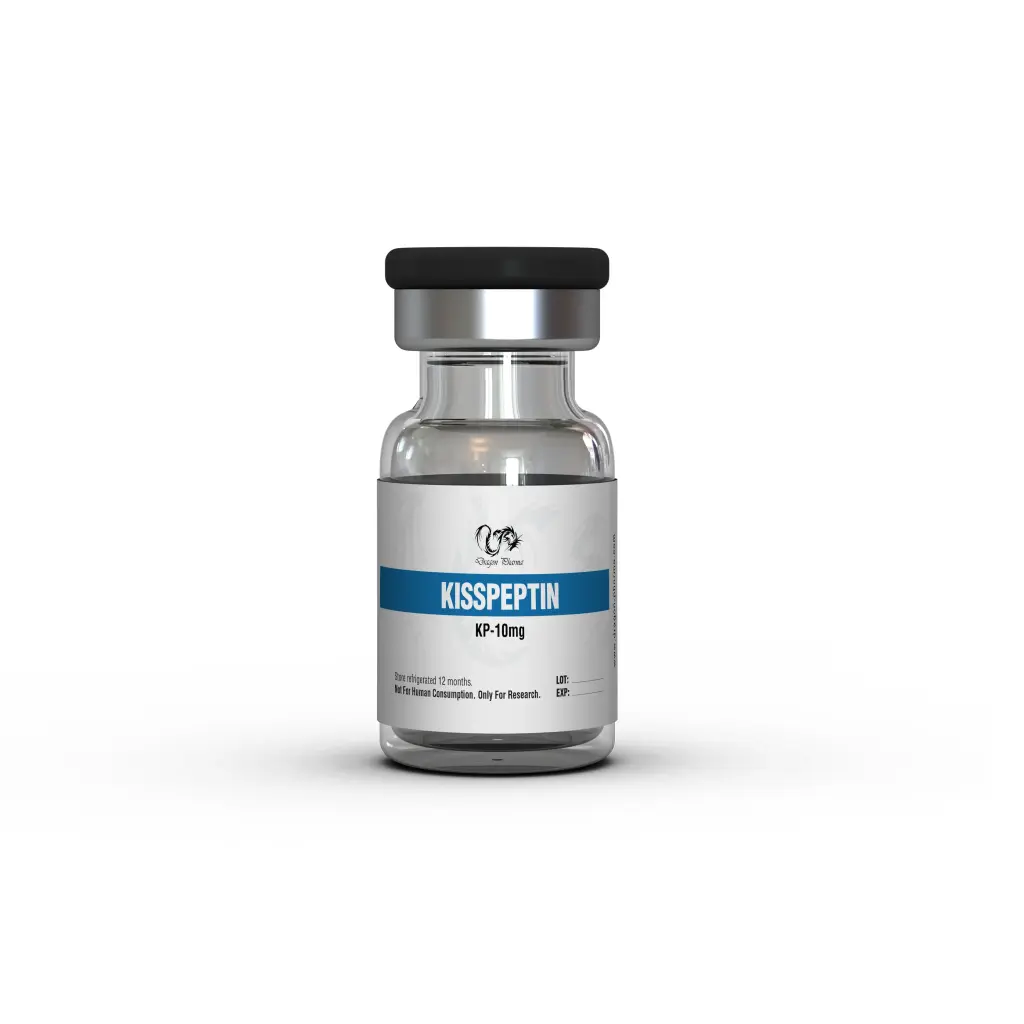
Manufacturer
Brand Dragon Pharma
Last Lab Tested None
Core Information
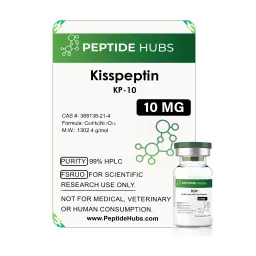
Substance Kisspeptin
Classification GnRH stimulator / reproductive peptide
Active Half-Life 30 minutes
Typical Dosage (Men) 100–200 mcg/day
Effects & Properties
Water Retention No
Aromatization No
Hepatotoxicity No
Hair Loss Risk (HBR) No
Acne No
Synthetic Decapeptide Research Compound
Kisspeptin-10 occupies a unique position in peptide research. Discovered first as a tumor metastasis suppressor in melanoma biology — the KISS1 gene name itself traces to that origin — it was later identified as the master upstream regulator of the hypothalamic-pituitary-gonadal (HPG) axis, controlling reproductive endocrinology at the level of GnRH pulse release from hypothalamic KNDy neurons. Few research peptides carry dual biological heritage across two fields as distinct as oncology and reproductive neuroendocrinology.
Dragon Pharma Kisspeptin-10 delivers the biologically active C-terminal decapeptide sequence Tyr-Asn-Trp-Asn-Ser-Phe-Gly-Leu-Arg-Phe-NH₂ in lyophilized research-grade form — the shortest naturally occurring fragment of the kisspeptin family that retains complete binding activity at its cognate receptor KISS1R (GPR54). The critical C-terminal amide (-NH₂), which defines the kisspeptin RFamide family and is structurally required for KISS1R engagement, is explicitly confirmed by LC-MS in every Dragon Pharma batch — a quality checkpoint that HPLC purity analysis alone cannot provide.
Product Specifications
| Parameter |
Detail |
| Brand |
Dragon Pharma |
| Compound |
Kisspeptin-10 (KP-10 / Metastin 45–54 / KiSS-1 45–54) |
| Sequence |
Tyr-Asn-Trp-Asn-Ser-Phe-Gly-Leu-Arg-Phe-NH₂
(YNWNSFGLRF-NH₂) |
| Peptide Length |
10 residues (decapeptide) |
| Fragment Origin |
KISS1 gene product, C-terminal residues 45–54 |
| Target Receptor |
KISS1R / GPR54 (Gq/11-coupled class A GPCR) |
| Receptor Affinity |
Ki ~2.33 nM (human KISS1R); ~1.59 nM (rat KISS1R) |
| Molecular Formula |
C₆₃H₈₃N₁₇O₁₄ |
| Molecular Weight |
1302.5 g/mol (monoisotopic: 1301.63 Da) |
| CAS Number |
374675-21-5 |
| PubChem CID |
25240297 |
| Purity |
≥99% (RP-HPLC) |
| Identity Verification |
LC-MS (sequence, mass, C-terminal amidation) |
| Appearance |
Lyophilized white powder |
| Solubility |
Water-soluble; bacteriostatic water for reconstitution |
| COA |
Independent third-party, per batch |
| Storage (dry) |
-20°C, protect from light; 24+ months stable |
| Storage (reconstituted) |
2–8°C, 28–30 days |
| Research Use |
In vitro research only |
KISS1R Pharmacology and Downstream Signaling
At its most fundamental level, Dragon Pharma Kisspeptin-10 is a tool compound for GPR54 pharmacology. KISS1R is a class A G protein-coupled receptor belonging to the Gq/11 subfamily, located at chromosome 19p13.3. It is the sole endogenous receptor for the kisspeptin family and serves as one of the most well-validated entry points for studying the neuroendocrine regulation of reproductive biology in laboratory settings.
When KP-10 engages KISS1R, the following signaling cascade is initiated:
- Gq/11 activation — G-protein coupling triggers phospholipase C (PLC) activation
- IP3 and DAG generation — PLC cleaves phosphatidylinositol 4,5-bisphosphate into inositol trisphosphate (IP3) and diacylglycerol (DAG)
- Intracellular Ca²⁺ mobilization — IP3 triggers endoplasmic reticulum calcium release producing rapid [Ca²⁺]i elevation
- PKC activation — DAG activates protein kinase C, which phosphorylates downstream substrates
- ERK1/2 phosphorylation — downstream MAPK signaling; a commonly measured endpoint in KISS1R activation studies
- β-arrestin recruitment — receptor desensitization pathway, measurable in KISS1R-expressing cell lines
Quantified receptor pharmacology: Ki ~2.33 nM (human KISS1R), ~1.59 nM (rat KISS1R); EC50 ~1.0 nM in CHO-GPR54 IP accumulation assays. These values establish Kisspeptin-10 as a high-affinity reference ligand suitable for binding competition assays, dose-response characterization, and comparative GPR54 pharmacology studies.
Five Active Research Domains
1. Neuroendocrine and HPG Axis Research
KP-10 is the primary tool compound for investigating hypothalamic-pituitary-gonadal axis regulation at the GnRH level. In hypothalamic models, KISS1R activation on KNDy neurons (co-expressing kisspeptin, neurokinin B, and dynorphin) drives pulsatile GnRH secretion, which governs downstream pituitary LH and FSH release and gonadal sex steroid biology. Research areas include GnRH pulsatility modeling, KNDy neuron circuitry characterization, puberty onset mechanisms, hypogonadotropic hypogonadism pathway investigation, and HPG axis regulation in both male and female reproductive biology contexts.
2. Cell Motility and Trophoblast Biology
The KISS1 gene was originally identified as a metastasis suppressor in melanoma — its product inhibits cell migration and invasion. In placental trophoblast research, KP-10 has been studied as a physiological inhibitor of cell motility. Research in HTR8/SVneo placental cells demonstrated reduced migration via an ERK1/2-p90rsk-GSK3β-FAK signaling feedback loop. In first-trimester trophoblast cultures, KP-10 raised intracellular calcium and inhibited motility without altering proliferation — consistent with a signaling-specific rather than cytotoxic mechanism. Downstream investigations have examined associated changes in MMP and TIMP expression, alongside VEGF-A modulation through KISS1R/ERK1/2 pathways.
3. Neuronal Protection Models
Published research has characterized a neuroprotective activity of Kisspeptin-10 in cholinergic neuronal models that operates independently of KISS1R binding — a mechanistically significant finding that opens a research thread entirely separate from GPR54 pharmacology. In SH-SY5Y-derived neurons engineered to overexpress wild-type or E46K mutant α-synuclein, KP-10 was shown to reduce α-synuclein-linked apoptosis and mitochondrial depolarization through receptor-independent direct peptide-protein interactions. This positions Kisspeptin-10 as a research tool for neurodegeneration biology relevant to conditions characterized by α-synuclein pathology, alongside its established role in GPR54 signaling.
4. Cardiac Fibroblast and ECM Biology
Research in cardiac fibroblast cultures has documented that Kisspeptin-10 increases intracellular collagen content through focal adhesion kinase (FAK) phosphorylation, alongside shifts in the balance between matrix metalloproteinases and their tissue inhibitors. This extends KP-10's documented biology into cardiovascular connective tissue research, creating a research application profile that spans neuroendocrine, reproductive, neuronal, and cardiac tissue systems — an unusually broad multi-system footprint for a ten-residue peptide.
5. Radiotheranostic and Imaging Research
Published work from 2025 demonstrated that a DOTA-conjugated Kisspeptin-10 analogue retained comparable KISS1R activation capacity to unconjugated KP-10, measured by inositol phosphate accumulation in KISS1R-expressing HEK293 cells. The conjugate was characterized for serum stability and evaluated as a potential gallium-68/lutetium-177 pan-tumour radiopharmaceutical targeting KISS1R-expressing tumours. This work positions the KISS1R system as a target for receptor-targeted radiotheranostic research — an emerging application domain for which unconjugated Kisspeptin-10 serves as the essential reference comparator.
In Vitro Research Applications
| Research Area |
Application |
| Receptor pharmacology |
KISS1R binding characterization; IP1 accumulation (HTRF); Ca²⁺ flux (fluorometric); ERK1/2 phosphorylation; β-arrestin recruitment |
| Neuroendocrine models |
KNDy neuron research; GnRH pulsatility; HPG axis pathway investigation; LH/FSH secretion signaling |
| Cell motility assays |
Trophoblast migration/invasion; ERK1/2-GSK3β-FAK loop characterization; HTR8/SVneo culture models |
| Extracellular matrix |
MMP/TIMP expression; VEGF-A pathway modulation; angiogenesis-related signaling in trophoblast cultures |
| Neuroprotection |
α-synuclein apoptosis and mitochondrial depolarization in SH-SY5Y cholinergic neurons; KISS1R-independent mechanism |
| Cardiac fibroblast |
FAK phosphorylation; collagen content modulation; MMP/TIMP balance in myocardial fibroblast culture |
| Radiolabeling chemistry |
DOTA-KP-10 analogue characterization; Ga-68/Lu-177 radiotheranostic receptor targeting research |
| Metastasis biology |
KiSS-1/GPR54 expression analysis in melanoma, gastric, pancreatic, ovarian, bladder, and prostate cancer cell line models |
Key Features
- ✔ C-terminal amide (-NH₂) confirmed by LC-MS per batch — the structural feature required for KISS1R binding potency; verified independently of HPLC purity which cannot detect this modification
- ✔ ≥99% purity by reverse-phase HPLC — research-grade threshold for receptor pharmacology, cell signaling, and in vitro biology applications
- ✔ Quantified KISS1R affinity (Ki ~2.33 nM human) — characterized as a high-affinity GPR54 ligand in published receptor binding assays; not inferred from biological activity observations alone
- ✔ Five distinct research domains in published literature — neuroendocrine, trophoblast motility, neuroprotection, cardiac fibroblast, and radiotheranostic applications, each supported by peer-reviewed studies
- ✔ Water-soluble — no organic co-solvent needed — dissolves directly in bacteriostatic water for standard laboratory concentrations; simplifies reconstitution protocol
- ✔ Lyophilized white powder without fillers — no excipients that could confound downstream assay results
- ✔ Independent third-party COA per batch — lot-specific documentation traceable from vial label to laboratory results; not reused across production runs
- ✔ Dual heritage: oncology + neuroendocrinology — KISS1 originally identified as metastasis suppressor in melanoma; later established as HPG axis master regulator; both research threads remain active
Research Context — WADA Classification: WADA has classified kisspeptin and agonist analogues under the Prohibited List category S2.2.1 (Testosterone-Stimulating Peptides in Males). This reflects the cascade by which KISS1R activation in hypothalamic KNDy neurons drives GnRH release, stimulating pituitary LH/FSH, and downstream gonadal testosterone production. Researchers involving Kisspeptin-10 in protocols with sports science, HPG axis, or testosterone-related research contexts should document this classification in institutional and ethical review materials. Dragon Pharma Kisspeptin-10 is supplied for in vitro research use only.
Research Benefits
The only endogenous high-affinity KISS1R ligand available in research-grade form. Kisspeptin-10 is the natural ligand for GPR54 — not a synthetic agonist analogue. This makes it the appropriate reference compound for any study establishing baseline receptor pharmacology, characterizing KISS1R-selective drug candidates, or building structure-activity relationships around the GPR54 binding domain. Synthetic analogues require KP-10 as the comparator; KP-10 requires no comparator.
Seven peer-reviewed publications directly supporting its research applications. Unlike many research peptides backed primarily by manufacturer descriptions or forum reports, Kisspeptin-10's research profile spans publications in Placenta, Journal of Cell Science, PLoS One, International Journal of Molecular Sciences, Scientific Reports, Genes & Diseases, and Journal of Neuroendocrinology — covering receptor pharmacology, trophoblast biology, neuronal protection, cardiac fibroblast, and radiotheranostic research respectively.
Receptor-independent mechanism opens a second research axis. The KISS1R-independent neuroprotective activity documented in SH-SY5Y models creates a research angle that does not require GPR54-expressing cell systems — expanding the compound's utility beyond receptor pharmacology into direct peptide-protein interaction research relevant to neurodegeneration biology.
A precision quality checkpoint other suppliers omit. Standard peptide quality assurance verifies purity by HPLC. Dragon Pharma additionally confirms C-terminal amidation by LC-MS — a structural feature that is invisible to chromatographic methods but is the defining characteristic of KISS1R-active kisspeptin. A non-amidated KP-10 at 99% purity is a different and inferior research compound.
Why Dragon Pharma Quality Matters for KP-10
Kisspeptin-10 presents a specific quality challenge that most research peptides do not: the C-terminal amide. This modification is not detectable by HPLC purity analysis. A batch of non-amidated YNWNSFGLRF-OH can show 99% HPLC purity while being pharmacologically inactive at KISS1R — it would fail every receptor binding assay while appearing flawless on a chromatogram.
Dragon Pharma's batch testing for Kisspeptin-10 explicitly includes:
- Reverse-phase HPLC — ≥99% purity, main peak area confirmation
- LC-MS — molecular ion confirmation at 1302.5 g/mol (average) / 1301.63 Da (monoisotopic); sequence verification; explicit C-terminal amide confirmation distinguishing YNWNSFGLRF-NH₂ from YNWNSFGLRF-OH
- Sterility and endotoxin testing — per batch
- Residual solvent screening
- Batch-specific independent COA — lot-traceable documentation from third-party laboratory
Product Summary
Dragon Pharma Kisspeptin-10 is a synthetic decapeptide (Tyr-Asn-Trp-Asn-Ser-Phe-Gly-Leu-Arg-Phe-NH₂ / KP-10 / CAS 374675-21-5) corresponding to the C-terminal 45–54 fragment of the KISS1 gene product. It is the primary endogenous ligand for KISS1R (GPR54), a Gq/11-coupled class A GPCR, with characterized binding affinity of Ki ~2.33 nM (human). Research applications span five documented domains: GPR54 pharmacology and neuroendocrine HPG axis signaling, trophoblast cell motility inhibition, KISS1R-independent neuroprotection in α-synuclein neuronal models, cardiac fibroblast collagen and FAK biology, and DOTA-conjugate radiotheranostic research. Supplied as lyophilized white powder at ≥99% HPLC purity, with LC-MS confirmation of sequence, molecular mass, and C-terminal amidation. Independent third-party COA per batch. For research use only.
Research domains: GPR54 pharmacology • Neuroendocrine signaling • Cell motility • Neuroprotection • Cardiac fibroblast • ECM biology • Radiotheranostic research