Manufacturer
Brand Dragon Pharma
Last Lab Tested None
Core Information
Substance Lysine-Proline-Valine (KPV)
Classification Synthetic anti-inflammatory peptide
Active Half-Life 2–4 hours
Typical Dosage (Men) 200–500 mcg/day
Effects & Properties
Water Retention No
Aromatization No
Hepatotoxicity No
Hair Loss Risk (HBR) No
Acne No
Main Benefits
Inflammation Support Gut, skin & systemic inflammation management
Popular Use Gut health, skin repair & recovery research
Common Stack BPC 157, TB 500, GHK
Main Goal Inflammation reduction & barrier protection
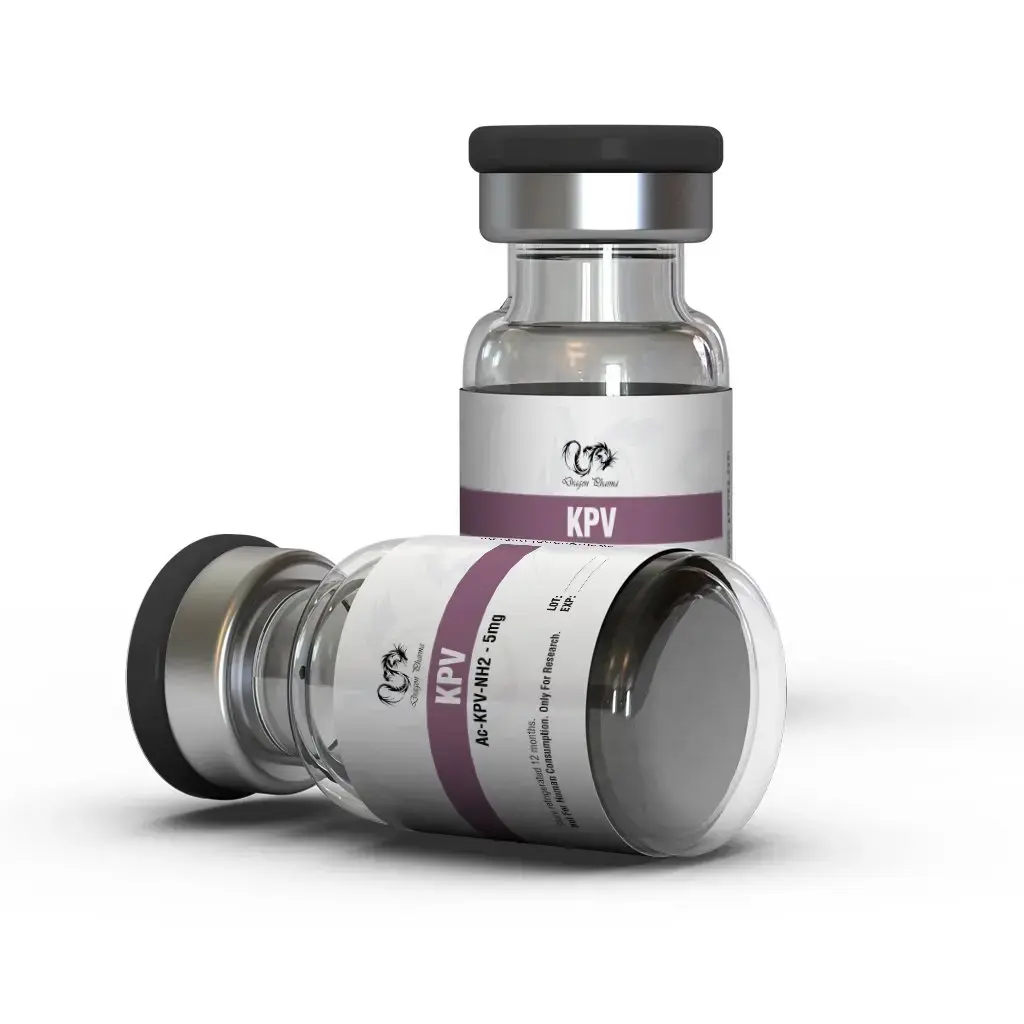
Dragon Pharma KPV 5mg
Dragon Pharma KPV 5mg is a pharmaceutical-grade anti-inflammatory tripeptide — Lysine-Proline-Valine — derived from the C-terminal fragment of alpha-melanocyte-stimulating hormone (α-MSH), a master regulator of immune and inflammatory responses. By isolating the KPV fragment from its parent hormone, researchers gain access to α-MSH's most potent anti-inflammatory activity in a compact, targeted format — without the pigmentation, appetite, and broader hormonal effects the full α-MSH molecule carries.
Supplied as a sterile lyophilized powder in a 2mL vial, Dragon Pharma KPV 5mg is studied for its role in gut barrier protection, wound healing, skin repair, systemic inflammation modulation, and training recovery — making it one of the most versatile anti-inflammatory research peptides currently available across multiple administration routes.
How Dragon Pharma KPV 5mg Works
KPV's mechanism is built around two primary biological targets — the melanocortin receptor system and the NF-κB inflammatory pathway — operating through complementary actions that distinguish it from both blunt-force anti-inflammatory drugs and single-mechanism peptides.
- Melanocortin receptor activation (MC1R and MC3R) — KPV binds to melanocortin receptors expressed on immune cells and inflamed tissue, reducing the release of pro-inflammatory cytokines including TNF-α, IL-1β, and IL-6 — the primary drivers of chronic inflammation, tissue breakdown, and recovery impairment
- NF-κB pathway inhibition — KPV's most extensively studied mechanism; by blocking NF-κB activation — the master transcription regulator of inflammatory gene expression — it prevents the inflammatory cascade from amplifying into the systemic, chronic state that underlies gut disorders, joint deterioration, and prolonged post-training recovery
- Epithelial barrier reinforcement — in gut research models, KPV strengthens intestinal epithelial integrity via PepT1-mediated tripeptide uptake, directly reducing bacterial translocation and toxin leakage that drive systemic inflammation from a compromised gut barrier
- Antimicrobial activity — KPV demonstrates mild antimicrobial properties that limit pathogen-driven inflammatory responses at wound and tissue sites, supporting the healing environment independent of its direct cytokine-suppressing action
- Local and systemic flexibility — KPV's tripeptide structure enables meaningful activity across multiple routes: topically for skin and wound research, orally for gut-focused protocols where GI tract stability is maintained via PepT1 transport, and subcutaneously for systemic inflammation research
Dragon Pharma KPV 5mg — Key Research Benefits
- Gut health and intestinal barrier integrity — suppresses mucosal inflammation in colitis and inflammatory bowel disease models, reinforces epithelial tight junctions to prevent leaky gut, and reduces systemic inflammatory load driven by bacterial translocation
- Skin repair and wound healing — accelerates wound closure by calming local inflammation and supporting tissue remodeling; studied for eczema, psoriasis, dermatitis, rosacea, and acne where overactive inflammatory responses drive chronic flare-ups
- Systemic cytokine suppression — TNF-α, IL-1β, and IL-6 reduction across multiple tissue types supports joint health, connective tissue recovery, and reduction of chronic inflammatory baseline
- No hormonal or androgenic activity — zero androgenic, estrogenic, or progestogenic activity; no HPA axis suppression; no hepatotoxicity — a safety profile fundamentally different from corticosteroids or anabolic-based anti-inflammatory approaches
- Training recovery support — by reducing exercise-induced inflammation and oxidative stress, KPV may support faster recovery turnaround and healthier long-term inflammatory baseline in high-volume training research
- Versatile administration routes — oral, topical, and injectable delivery all maintain KPV activity, allowing the same compound to serve gut, skin, and systemic research applications
Dragon Pharma KPV 5mg Dosage Guide
KPV has a plasma half-life of approximately 2–4 hours, supporting daily or twice-daily administration in research protocols requiring consistent systemic exposure. Reconstitute with bacteriostatic water under aseptic conditions before use.
| Protocol |
Daily Dose |
Administration |
| Starting / Low |
100–200 mcg/day |
SubQ or oral |
| Standard Research |
200–500 mcg/day |
SubQ, oral, or topical |
| Advanced / Systemic |
500 mcg–1mg/day |
SubQ injection |
Route-specific guidance:
- Oral — for gut inflammation and intestinal barrier research; KPV demonstrates GI tract stability via PepT1 transporter-mediated uptake, maintaining bioactivity in intestinal tissue
- Subcutaneous injection — for systemic inflammation, joint health, and recovery research; provides consistent plasma exposure across the 2–4 hour half-life window
- Topical — formulated into cream or gel base (0.1–1%) for skin repair, wound healing, eczema, psoriasis, and dermatological inflammation research
- Cycle length: 4–12 weeks, reflecting the chronic nature of inflammatory processes under study
KPV vs Other Anti-Inflammatory Research Compounds
| Compound |
Primary Mechanism |
vs KPV |
| KPV |
NF-κB inhibition, MC1R/MC3R activation |
Inflammation regulation — resets immune response |
| BPC-157 |
Angiogenesis, nitric oxide balance |
Structural repair — rebuilds tissue post-inflammation |
| TB-500 |
Actin sequestration, cell migration |
Systemic repair — drives cell proliferation |
| GHK-Cu |
Collagen/elastin synthesis |
Structural rebuilding — skin and connective tissue |
| NSAIDs |
COX enzyme inhibition |
Blunt force — GI and kidney side effects |
| Corticosteroids |
Broad immune suppression |
Full suppression — HPA axis disruption risk |
Stack logic: KPV addresses inflammation regulation — use it first to calm the inflammatory environment, then layer BPC-157 or TB-500 for structural repair once the inflammatory baseline is controlled.
Research Stacking Protocols
Comprehensive Tissue Repair Stack:
- KPV 5mg: 200–500 mcg/day — inflammation regulation and barrier protection
- TB-500: standard research dose — cell migration and structural recovery
- BPC-157: standard research dose — angiogenesis and tissue repair
KPV calms the inflammatory environment; TB-500 and BPC-157 rebuild the damaged structure — a sequenced approach to the complete healing cascade.
Skin Rejuvenation and Collagen Stack:
- KPV 5mg: topical 0.1–1% or 200 mcg SubQ daily
- GHK-Cu: standard research dose — collagen synthesis and antioxidant support
KPV reduces inflammatory drivers of skin damage; GHK-Cu rebuilds collagen and elastin structure — complementary anti-inflammatory and regenerative mechanisms.
Gut Health and Recovery Stack:
- KPV 5mg: 200–500 mcg oral daily — gut barrier integrity and mucosal inflammation
- BPC-157: standard research dose — GI tissue repair and angiogenesis
Both compounds demonstrate complementary gut-specific activity — KPV via PepT1-mediated epithelial barrier reinforcement, BPC-157 via tissue repair and blood flow restoration to damaged mucosal tissue.
Results Timeline
- Days 1–7: Initial cytokine suppression measurable in research models; early reduction in localized inflammation markers; topical application shows early redness and irritation reduction
- Weeks 2–4: Measurable gut barrier improvement in intestinal inflammation models; progressive wound closure acceleration; systemic inflammatory baseline reduction
- Weeks 4–8: Sustained cytokine suppression; significant skin repair outcomes in dermatological models; joint inflammation reduction and training recovery improvement
- Weeks 8–12: Peak anti-inflammatory and barrier-protective outcomes; chronic inflammation research endpoints most clearly measurable at extended protocol duration
Side Effects and Safety Profile
Dragon Pharma KPV 5mg demonstrates one of the most favorable safety profiles of any research peptide — a direct consequence of its targeted mechanism and naturally-occurring α-MSH fragment structure.
- No androgenic, estrogenic, or progestogenic activity — zero hormonal side effects, no suppression of endogenous testosterone production
- No HPA axis suppression — unlike corticosteroids, KPV does not disrupt adrenal function or long-term immune competence
- No hepatotoxicity — no liver stress at any standard research dose
- Mild injection site redness — most commonly reported effect; transient and resolving quickly; minimized by aseptic technique and injection site rotation
- Mild GI upset — possible at higher oral doses; managed by starting at the lower end of the research range
- Short detection window — 2–4 hour half-life results in rapid amino acid metabolism; no long-term detectable signature in standard drug screening
Why Dragon Pharma KPV 5mg?
Dragon Pharma's pharmaceutical-grade manufacturing ensures every vial of KPV 5mg delivers verified tripeptide concentration, structural integrity, and consistent NF-κB pathway activity across research batches:
- Confirmed 5mg KPV concentration per vial through independent third-party laboratory analysis
- Sterile lyophilized powder in 2mL vial — preserving full bioactivity through reconstitution and storage
- Pharmaceutical-grade synthesis maintaining the precise Lysine-Proline-Valine sequence essential for MC1R/MC3R receptor binding activity