Manufacturer
Brand Dragon Pharma
Last Lab Tested Soon
Core Information
Substance KPV; BPC-157; TB-500; GHK-Cu
Classification Recovery Peptide Stack
Active Half-Life Variable (2–6 hours range)
Typical Dosage (Men) 500–1000 mcg/day
Effects & Properties
Water Retention No
Aromatization No
Hepatotoxicity No
Hair Loss Risk (HBR) No
Acne No
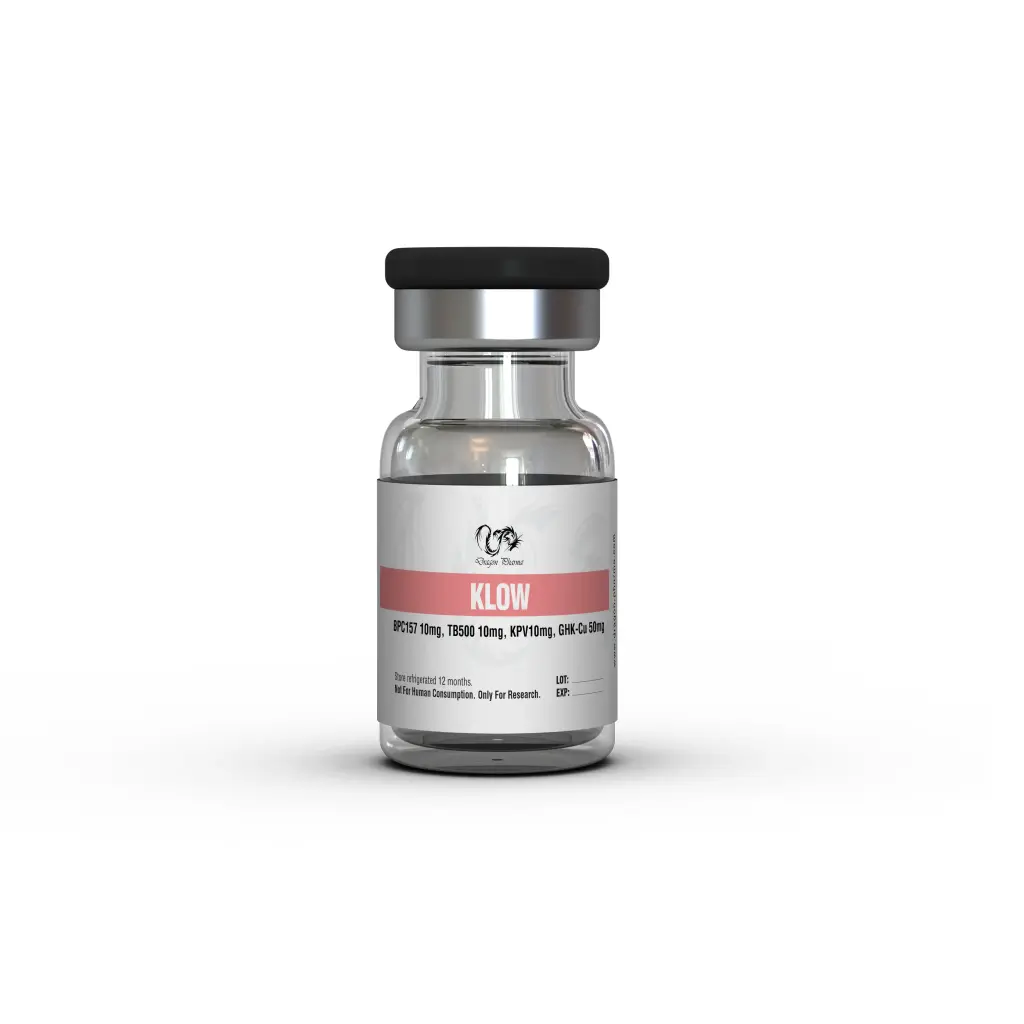
Dragon Pharma KLOW 80mg
Recovery research rarely fails because of one missing mechanism — it fails because injury repair is a multi-stage process, and most single-peptide protocols only address one stage of it. Blood supply to damaged tissue, cellular migration to the injury site, structural rebuilding of collagen, and inflammation control all happen on different timelines, through different receptors, using different biological machinery entirely.
Dragon Pharma KLOW 80mg was formulated around this exact problem: a peptide research blend — BPC-157, TB-500, GHK-Cu, and KPV — where each component corresponds to a different stage of the healing timeline, reconstituted in a single 2mL vial. The result is a KLOW peptide blend that research subjects can administer as one injection rather than coordinating four separate peptide schedules.
The Healing Timeline — and Where Each KLOW Component Fits
Tissue repair research generally follows a recognizable sequence. Mapping the four KLOW peptides onto this sequence explains why the combination was designed this way — not as four random "recovery peptides" bundled together, but as a timeline-matched protocol.
Stage 1 — Restoring Blood Flow (BPC-157)
Before any repair can happen, damaged tissue needs blood supply. BPC-157, a stable gastric-derived peptide, is researched for its role in angiogenesis — new blood vessel formation — which is the foundational step that everything downstream depends on. Without adequate vascularization, cell migration and collagen deposition in later stages have nothing to build on.
Stage 2 — Mobilizing Repair Cells (TB-500)
Once blood flow is established, repair cells need to migrate to the injury site. TB-500 (Thymosin Beta-4) is researched for its role in actin sequestration — a mechanism that directly governs cell migration and proliferation. This is the stage responsible for the flexibility and mobility improvements often reported in sprain, strain, and tendonitis research.
Stage 3 — Rebuilding Structure (GHK-Cu)
With cells now present at the injury site, the structural rebuild begins. GHK-Cu, a copper-binding tripeptide, is researched for collagen and elastin synthesis — the literal rebuilding material for tendons, ligaments, skin, and connective tissue. Its antioxidant properties also support the cellular environment during this high-activity repair phase.
Stage 4 — Controlling the Inflammatory Response (KPV)
Throughout all three stages, inflammation needs to be regulated — too much, and repair is disrupted; too little, and the initial healing signal never triggers. KPV, a melanocyte-inhibiting factor tripeptide, is researched for anti-inflammatory activity in gut and skin tissue, helping maintain the balance that allows the other three stages to proceed without excessive inflammatory interference.
The structural logic: rather than four peptides chosen because they're each individually popular, KLOW's formulation corresponds to four sequential requirements of the healing process itself — blood supply, cell migration, structural rebuilding, and inflammation regulation.
What This Means for Research Applications
Because Dragon Pharma KLOW 80mg addresses sequential stages rather than parallel redundant mechanisms, its research applications tend to cluster around conditions where multiple healing stages are simultaneously relevant:
- Soft tissue injuries — torn ligaments, muscle strains, and tendon damage involve all four stages: vascular damage, cellular repopulation, structural rebuilding, and localized inflammation
- Chronic tendonitis — persistent inflammation (Stage 4) often prevents structural repair (Stage 3) from completing; addressing both simultaneously is a common research focus
- Joint integrity research — joint tissue depends heavily on collagen turnover (Stage 3) and inflammation control (Stage 4), with vascularization (Stage 1) relevant in cartilage-adjacent research
- Post-training recovery protocols — microtrauma from intense training triggers a smaller-scale version of the same four-stage process; researchers studying training resilience often examine whether accelerating this cycle improves recovery turnaround
- Skin and connective tissue research — GHK-Cu's collagen/elastin role and KPV's anti-inflammatory profile extend KLOW's relevance beyond musculoskeletal research into skin healing and connective tissue studies
Reconstitution and Dosing Protocol
Dragon Pharma KLOW 80mg is supplied as a lyophilized powder in a 2mL vial. Reconstitute with 2mL bacteriostatic water to achieve a working concentration of 40mg/mL — gently swirl, do not shake, and store refrigerated and protected from light.
| Protocol |
Daily Dose |
Cycle Length |
| Beginner |
500 mcg/day |
4–6 weeks |
| Advanced |
750–1000 mcg/day |
6–8 weeks |
Dosing math reference: at 40mg/mL, a 500mcg dose equals 0.0125mL — 12.5 units on an insulin syringe.
Administration routing reflects the healing-stage logic above:
- Site-localized injection — when researching a specific injury (e.g., a known tendon or ligament site), injection near that location concentrates all four stages of the cascade where it's needed
- Systemic subcutaneous injection — abdominal SubQ administration for research into broader recovery, joint health, or skin/connective tissue outcomes not tied to one specific site
- Use aseptic technique throughout reconstitution and administration
Building a Research Protocol Around KLOW
Because KLOW's four stages are foundational to tissue repair generally, it functions as a base layer that other research compounds can be added to depending on the broader research question — rather than KLOW peptide being added on top of something else.
Standalone — Single Injury Focus (8 weeks):
Dragon Pharma KLOW 80mg: 500–750 mcg daily. Appropriate when the research question is specifically about the healing cascade itself — e.g., a torn ligament or chronic tendonitis case study.
+ GH Axis Compounds — Recovery Plus Growth (6 weeks):
Here, KLOW's four-stage tissue repair runs alongside GH/IGF-1 elevation — relevant when the research question involves whether elevated GH accelerates the healing timeline KLOW addresses.
+ Metabolic Compounds — Recomposition with Joint Support (8 weeks):
Here, KLOW's Stage 3/4 (structural and anti-inflammatory) components support joint integrity during caloric deficit research — relevant because cutting protocols often place additional stress on connective tissue while reducing the nutritional resources available for collagen synthesis.
Safety Profile — Why KLOW's Side Effect Range Is Narrow
The reason Dragon Pharma KLOW peptide side effect profile is narrower than hormonal research compounds traces back to the same four-stage framework: none of the four peptides interact with androgen receptors, the aromatase enzyme, or the HPG axis. They operate on tissue-repair machinery, not endocrine signaling.
Reported effects (typically mild, dose-dependent):
- Injection site reactions — redness, itching, mild pain; most common and shortest-lived
- Fatigue or lethargy — particularly during the first 1–2 weeks of adaptation
- Headaches — mild, transient
- Numbness or tingling — rare, most often linked to GHK-Cu
What this framework explains KLOW does NOT cause:
- No androgenic effects (acne, hair loss) — no androgen receptor interaction
- No aromatization or estrogenic activity — none of the four peptides are aromatase substrates
- No water retention or blood pressure changes — no mineralocorticoid pathway involvement
- No hepatotoxicity — no hepatic first-pass metabolism burden from oral 17-alpha alkylation (KLOW is injectable, not oral)
If KLOW is researched alongside aromatizing compounds in a broader stack, Aromasin remains the standard aromatase inhibitor for those compounds — KLOW's four peptides require no estrogen management of their own.
Why Dragon Pharma KLOW 80mg?
The four-stage framework only delivers research value if each peptide is present at the concentration the framework assumes. Dragon Pharma's pharmaceutical-grade manufacturing verifies exactly that:
- Verified 80mg combined concentration (BPC-157, TB-500, GHK-Cu, KPV) per vial — independent third-party laboratory tested
- Pharmaceutical-grade lyophilization preserving bioactivity across all four components through the reconstitution process
- The only multi-stage healing cascade peptide blend in the Dragon Pharma research line — formulated around sequential repair biology rather than arbitrary peptide bundling



November 14, 2025
I’ve been waiting for this product for a long time, and I’m really excited to finally get it. I’ve used Klow peptides before and was very satisfied, so I’m looking forward to trying this one as well. Can’t wait for it to arrive. Thank you, for offering products like this!